
Winding down
100 Years Ago: 29 August to 8 September 1925

Day 1
Leyton: Essex v Leicestershire
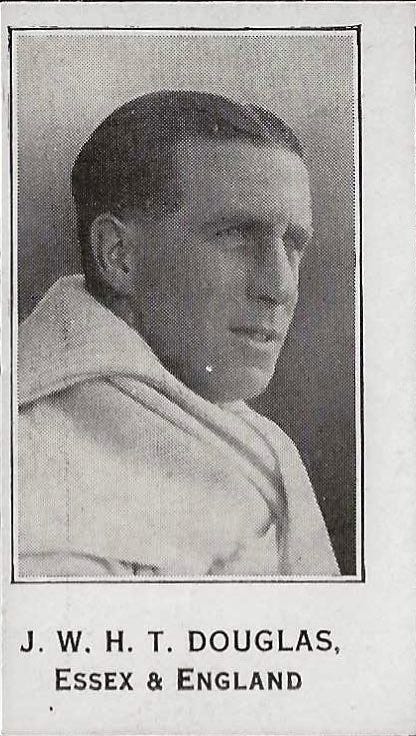
Johnny Douglas returned to the Essex team today. The first quarter of an hour saw the best batting of the day, as John Freeman, often a dogged batsman, hit four boundaries, all fine strokes. These were few and far between for the rest of the day. Frank Bale rarely makes any headlines for Leicestershire as a steady left-arm slow-medium spirited bowler, but today he bowled with great accuracy and the strokes dried up as he bowled down the first three wickets, all deceived by his spin. Ewart Astill also bowled very well, and soon after lunch Essex were 67 for six. Douglas now came to the rescue, aided by an unusually dogged Frank Gilligan, and they added 69 runs in an hour and 40 minutes. When Douglas was out the innings folded quickly. Astill bowled 22.5 overs and took four wickets for only 13 runs — very good bowling, but flattered by the batsmen. The Leicestershire bowlers as a whole did a good job on a good pitch.
Leicestershire went in for the last hour and a quarter of play, and Eddie Dawson and Alan Shipman made 34 for the first wicket. The next two batsmen played poor strokes and did not last long, and Leicestershire had three down by the close, with Shipman still there.
Swansea: Glamorgan v Nottinghamshire
There was a wet pitch at Swansea drying under the sun and certain to be sticky. Johnnie Clay had a difficult decision to make on winning the toss, as both sides have a bowler (Frank Ryan for Glamorgan, Len Richmond for Nottinghamshire) renowned for skill on such a pitch, and perhaps it was the knowledge that pitches at Swansea crumble quickly that persuaded Clay to bat first. With Arthur Carr and his deputy captain both unable to play, Nottinghamshire had to take the unsavoury step of appointing a professional in George Gunn as captain for this match.
Glamorgan quickly lost Cyril Walters for 1, but then followed a promising partnership for the second wicket between Maurice Turnbull and Eddie Bates. After they had taken the score to 31 Gunn rather belatedly brought on Richmond to bowl, and he immediately bowled Turnbull for 14. Wickets tumbled quickly after that and in less than two hours Glamorgan were dismissed for 93, with Richmond taking five wickets for only 18 runs.
The Nottinghamshire innings followed a similar pattern, though on a slightly larger scale. Jack Mercer bowled Dodger Whysall for 1, but Gunn and Ben Lilley took the score to 50 before the former was bowled by Ryan. Then wickets fell rapidly, although Ryan was more expensive than Richmond had been. Nottinghamshire took the lead with six wickets down and eventually finished 32 runs on. The Glamorgan fielding was brilliant, especially the running catch taken by Walters on the boundary to remove the last man, Frank Matthews.
By now the pitch was improving, but nobody told the Glamorgan batsmen. This time it was the pace of Harold Larwood that shook Glamorgan. He had Walters caught at the wicket off the second ball of the innings, and took three of the four wickets that went down for 18, the fourth being a run-out. Frank Pinch was the only batsman who was able to come to terms with the bowling, although Trevor Arnott gave him useful support with 10 runs before he was out in the last over of the day. Glamorgan are only 21 runs on with five wickets down.
Dover Week: Kent v Lancashire
For the first time the three brothers, Jack, Ronnie and Godfrey Bryan played in the Kent team together. In 1889 Kent also had George, Frank and Alec Hearne in the same team. All the Bryans bat left-handed, giving Kent five left-handed batsmen in their team. The pitch was dry and even-paced. Harry Makepeace, fit again, played a solid innings for Lancashire, while Charlie Hallows made a bright 31 before he was out with the score at 49 — Makepeace then had 8. Freeman quickly trapped Don Davies and Frank Watson lbw without a run with his top-spinner. Makepeace, batting for two hours and 40 minutes, and Alfred Pewtress rescued the innings with a fourth-wicket partnership of 82, and later Jack Iddon, making some fine drives off Frank Woolley and Freeman in particular, and the unorthodox Walter Farrimond, standing in for George Duckworth, made useful runs to give Lancashire a moderate score. The leg-spinners Freeman and Father Marriott — the latter’s style is the faster of the two — took most of the wickets with excellent bowling, but Charlie Wright bowled very well with no luck at all.
Kent had an hour to bat. Wally Hardinge and Jack Bryan put on 41 for the first wicket, and after Hardinge was caught at cover Woolley came in and played with great ease and grace until the close, leaving the match fairly well balanced at this stage.
Lord’s: Middlesex v Surrey
The Middlesex aim today when batting first seemed to have been to make themselves safe from defeat. For most of the day their batting was a dull plod, with little to excite a large crowd of about 15,000, despite today being the opening of the football season. This was against weak Surrey bowling on a fine batting pitch. Greville Stevens and Harry Lee, opening the innings, spent most of the time before lunch patting the ball back down the pitch, with Stevens almost eliminating any backlift. It seemed that the only way Surrey could taken a wicket was with a run-out, and that is what happened, thanks to a fine throw from Andy Sandham. The bowling may have been feeble, but the Surrey fielding throughout the day was excellent. The first wicket put on exactly 100 runs and Stevens was run out for 54.
Lee did not long survive him, but there followed another long boring stand between Jack Hearne and Patsy Hendren — all the first four batsmen reached fifties, and they all took a laborious two hours in fine conditions to do so. Hendren did start to show more aggression later in the day, though, and just reached his century before the close. Frank Mann tried to attack the bowling, but was bowled out for 7, and Nigel Haig for 5, just before the close.
Taunton: Somerset v Warwickshire
Warwickshire made a poor start to their innings, with five batsmen out for 71, of which Len Bates had made 33. Freddie Calthorpe led a recovery, helped by Reg Santall in a partnership of 42 for the sixth wicket, but the biggest boost came from Arthur Croom and Bob Wyatt, who added 77 for the eighth wicket. Somerset bowled well and fielded even better, but Warwickshire would have expected to do better than 223.
Somerset’s batting was scarcely an improvement on this, as they lost their first three wickets for 47, but their rescuers were Dar Lyon and Randall Johnson, who put on 65 for the fourth wicket with some good aggressive play. Lyon was still there at the close, where the teams appeared to be quite evenly balanced.
Hove: Sussex v Yorkshire
The pitch at Hove was soft and lifeless, and the outfield thick, so run-scoring was handicapped, and in fact there were only four fours reached the boundary in the entire Sussex innings. The weather was fine and warm. Sussex lost two wickets for 18 and their middle order opted for defence after that, which proved to be a dubious policy. The only real partnership of the innings was that of 43 for the fifth wicket, between Bert Wensley, who batted well, and Ronnie Holdsworth, almost strokeless. Near the end Arthur Watson played one of his usual aggressive innings, landing a six over long-on on a table in the midst of a party of delighted schoolboys taking tea and smashing the crockery. The Yorkshire bowlers shared the wickets around, but Wilfred Rhodes was the best of them, bowling with beautiful flight and length, tossing the ball up but giving away only 17 runs off 18 overs for three wickets.
The lifeless pitch did not suit George Macaulay, who took only one wicket, and neither did it suit Maurice Tate when Yorkshire batted for the final two hours — not encouraging when these two bowlers are considered to be England’s main weapons against Australia next season. Percy Holmes and Herbert Sutcliffe began the Yorkshire batting well and looked to be on course for another of their century opening partnerships, but having scored 36 out of 58 Holmes was unlucky to play a ball on to his pads, from whence it rebounded on to his stumps. Shortly after that Sutcliffe on 20 was dropped at slip, and by the close Yorkshire appeared to be in a strong position.
Worcester: Worcestershire v Hampshire
The pitch at Worcester seemed to be a good fast one that gave a little help to the bowlers, and the batting of both teams, who had little or nothing to play for, was poor. Fred Root had plenty of incentive, though, as he successfully became the first Worcestershire bowler to take 200 wickets in a season. Cliff Wilson regained his good bowling form and the two of them bowled out Hampshire for 180. Alec Bowell and Phil Mead dug in to play dogged innings approaching two hours in length, while Lionel Tennyson smashed 17 runs off Wilson only to be caught when facing Root for the first time. Root’s figures would have been better still had he not had two chances missed off his bowling.
Worcestershire never looked like taking advantage of their visitors’ failings or challenging their 180, with three wickets going down to Alec Kennedy for 21 and five out for 63. Root and Maurice Foster made something of a recovery, but then the last five wickets went down for 7 runs and Hampshire gained a lead of 57 on the first innings.
Day 2
Leyton: Essex v Leicestershire
Alan Shipman seems to have completed successfully a transition from pace bowler who could bat to stodgy opening batsman who can no longer take wickets. Today he hung on to the crease like a limpet for five hours to compile a maiden first-class century. He had three good partners to help him, George Geary in a stand of 53 for the fifth wicket, James Bradshaw in 83 for the sixth, and finally the aggressive Tommy Sidwell saw him to his century with 55 for the ninth wicket in only 35 minutes. After the fifth wicket had fallen at 105, the last five wickets added another 167 runs, and Leicestershire took a lead of 124 on the first innings. Boring as it undoubtedly was, and it contained only one boundary, Shipman’s century was an invaluable innings for his side.
When Essex went in again, John Freeman again made an unusually fluent start and with Jimmy Cutmore put on 73 for the first wicket. Then came a disastrous collapse to the bowling of Ewart Astill and Frank Bale, as seven wickets fell for the addition of only 19 runs, leaving Essex looking doomed to defeat tomorrow. Well as Astill and Bale bowled, the collapse was inexcusable. Essex will start tomorrow still 26 runs in arrears and only three tail-enders left.
Swansea: Glamorgan v Nottinghamshire
Glamorgan began the day in a difficult position, only 21 runs on with five wickets down already. They put up a hard fight in conditions that were never too easy. Frank Pinch made the only individual score of the match over 30, making a good aggressive fight with Johnnie Clay so that they were at least able to set Nottinghamshire a target of 97. Len Richmond again caused them trouble, but the main danger was Harold Larwood, who bowled at a great pace and corresponding accuracy to take five wickets in conditions that did not really suit him.
Then fine bowling and the usual brilliant Glamorgan fielding made the visitors fight hard for victory, losing five wickets before they got there. Their fine fielding saw Ben Lilley and George Gunn run out in succession, due to the fine fielding of Maurice Turnbull and Johnnie Clay.
Dover Week: Kent v Lancashire
The weather was beautiful at Dover and the crowd the largest at the ground for many years, it is said. The pitch was faster and the day began with an excellent partnership between Jack Bryan and Frank Woolley. They added 103 for the second wicket, with Woolley the leading figure, although Bryan scored quickly enough by taking full advantage of all the loose balls. Woolley completed his 2000 runs for the season, at one stage hitting Ted McDonald for 15 runs in an over, before that bowler dismissed them both to catches behind the wicket and started a middle-order collapse. John Knott played some fine strokes before being bowled by a brilliant breakback from McDonald, and Jack Hubble fought hard, but nine wickets were down for 227 when the last man, Father Marriott, joined Hubble with Kent still 8 runs behind. Marriott batted surprisingly well for 12 not out, Hubble rose very well to the occasion, and this last pair added 33 to take Kent into the lead. Overall McDonald bowled superbly, mostly at medium pace but with occasional very fast ones.
Harry Makepeace and Charlie Hallows began the Lancashire second innings with a partnership of 42, which was going well before both were out, and the top order began to fail. Five wickets were down for 75, but Frank Watson settled in and played a fine innings. Jack Iddon and Dick Tyldesley both gave him useful support, but at the close the last two batsmen were together and Lancashire were only 144 runs ahead, so Kent will be hopeful of victory tomorrow.
Lord’s: Middlesex v Surrey
It only took 20 minutes for Middlesex to lose their last four wickets this morning, all of them to the pace bowling of John Lockton, who bowled far better and with more life than he or any of the Surrey bowlers had shown yesterday. Patsy Hendren was his first victim, playing the ball on to his stumps after batting for about 3½ hours.
Jack Hobbs and Andy Sandham put on 34 for the first Surrey wicket before Jack Durston broke through, having Jack Hobbs caught at the wicket for 34 and then bowling Donald Knight first ball with a vicious breakback. When Tom Shepherd went for 7, Sandham and Douglas Jardine had to dig in, which they did very solidly. After lunch they continued their stand, which eventually added 116 for the fourth wicket. But then wickets started falling again, with Sandham out, bowled by Jack Hearne, just short of his century, perhaps paying the penalty for showing too much caution in the nineties. The only other batsman to do much was Alan Peach, who hit out to score 46 in 40 minutes. Durston took the last four wickets to fall to finish with six, and Middlesex led by 69 on the first innings.
They batted for an hour and a quarter this evening in their second innings, and the top three showed what they can do with more positive intent than they showed in their first innings. Harry Lee went for 17 to a fine catch by Bert Strudwick, and Greville Stevens and Jack Hearne played freely without taking any risks to put Middlesex 164 runs ahead with just one wicket down by the close. The onus on them is to get enough runs and leave enough time to bowl Surrey out tomorrow.
Taunton: Somerset v Warwickshire
There was plenty of action at Taunton today, and Warwickshire had the best of it almost from start to finish. The heavy dew helped the bowlers before lunch, and the Warwickshire pacemen Harry Howell and Edward Hewetson finished off the Somerset first innings in just over an hour, with Dar Lyon fighting an almost lone battle to score 58. This gave Warwickshire a lead of 57.
Warwickshire lost three wickets for 69 before lunch, but after the innings the pitch became easier and their middle order cashed in. Freddie Calthorpe and Charles Fiddian-Green put on 95 for the fifth wicket and runs came at a good pace. The score was helped by Lyon, who had a bad day behind the stumps and conceded 31 byes in the innings. Fiddian-Green held the innings together and was unbeaten at the end. Somerset fielded very well but their bowling was weakened by the absence of Raymond Robertson-Glasgow with a knee injury.
Somerset were left with an almost hopeless target of 379 to win, and in half an hour before the close they lost both openers for 36 runs, with their leading batsman Jack MacBryan running himself out trying to take a risky second run in the last over of the day.
Hove: Sussex v Yorkshire
The weather today was bright and sunny after a misty start, and the pitch and outfield were faster than they were yesterday. Yorkshire continued their innings with typical machinelike efficiency, taking no chances but keeping the runs coming steadily. Sussex fielded well and took their catches, but could not prevent Yorkshire gaining a big lead. Maurice Leyland and Wilfred Rhodes put on a good 81 for the fourth wicket which took Yorkshire into the lead, and later George Macaulay played a good innings, being allowed to score many runs through almost vacant places on the leg side. Bert Wensley was the main danger for the batsmen, bowling much more effectively than Maurice Tate; he swung the ball in the air and moved it into the batsmen off the pitch, taking the first six wickets in the innings and using the second new ball particularly well. Yorkshire still almost doubled the Sussex score, gaining a lead of 149 on the first innings.
Sussex made a bad start again, with George Macaulay whipping out Ted Bowley and Dick Young for only 10 runs on the board. But then Tate and Wensley, after all their bowling efforts, put in a noble job with the bat as well. They chose the aggressive mode and showed what might have been done in the first innings, reaching a century partnership in just under an hour. By the close both had passed their fifties and they were only 10 runs behind the Yorkshire score with eight wickets in hand. Sussex have caved in feebly to many opponents this season, but they are now giving Yorkshire quite a fight. But with Yorkshire’s all-round strength and resilience they still have a lot to do if they are to save the match.
Worcester: Worcestershire v Hampshire
This was Fred Root’s Match. Hampshire went in for their second innings, perhaps a little complacently, having a first-innings lead of 57. Root bowled in his very best form, though, and their first four wickets went down for 22 runs, including Phil Mead, caught off Root for 2. Alex Bowell was the only batsman to put up much of a fight, managing 21 runs before Root bowled him; he was the only batsman to reach double figures. Root finished with seven wickets for 23 runs, and match figures of twelve for 101. He was well supported by Cliff Wilson, who took the other eight wickets, and the pair bowled unchanged throughout the innings, which lasted only 1¼ hours. So effective were they that Dick Pearson, usually Root’s regular stock bowler at the other end, did not get to bowl a ball in the match.
Worcestershire needed to score 109 to win, no foregone conclusion for them, but they made no mistake about it. Pearson and Charles Tarbox gave them a confident opening partnership of 52, and after Pearson was out on the verge of victory, Root had the honour of coming in and hitting the winning runs off Hampshire’s best bowler, Alec Kennedy.
Day 3
Leyton: Essex v Leicestershire
Essex needed another 26 runs this morning to avoid an innings defeat, and this at least they achieved, thanks to a ninth-wicket partnership of that number between Robert Sharp and Stan Nichols. But Leicestershire needed only two balls to complete their victory, as the wicket-keeper Frank Gilligan was given the ball and Tommy Sidwell hit them for two and four. This was a disappointing end to a much improved season by Essex, but they still retain their seventh place in the championship table — the best of any county outside the Big Six. Leicestershire, although in 12th place, were greatly encouraged to finish their season with three successive victories — a poor season ending in hope.
Dover Week: Kent v Lancashire
This match had an unexpectedly thrilling finish, as when the day began, and Lancashire could add only 7 runs to their overnight score, which set Kent 152 to win, a target they would expect to chase down on this good pitch. There seemed, however, to be a spot on the pitch that McDonald found and exploited well.
Kent lost Jack Bryan for a single, and then wickets began to go down steadily to McDonald, who took the first five to fall at fairly regular intervals with superb bowling, varying his pace all the time, making it fly dangerously sometimes and moving the ball off the pitch. Frank Woolley, always a potential match-winner, was bowled by a particularly fast ball from McDonald for 17, and strangely five successive batsmen in the order were out for scores of between 13 and 17 — Woolley was to finish the second-highest scorer of the innings. At first McDonald was partnered by Frank Watson, who bowled steadily and economically, but then he was replaced by Cecil Parkin, rather a gamble in view of that man’s erratic bowling recently. This time Parkin rose to the occasion, though, and bowled superbly opposite McDonald, who was never rested apart from the lunch interval.
When Kent lost six wickets for 85, and had eight down for 123, Lancashire looked the more likely victors. Lancashire were turning in one of their best fielding performances. The difference was made by Godfrey Bryan. When Charlie Wright at No 10 joined Bryan the last two wickets had to make another 28 runs to win. Bryan decided on positive play, taking on both Parkin and McDonald and aiming to hit them off their lengths, beginning with 10 runs in an over from Parkin that tipped the balance, and the score mounted. Finally Wright, after surviving one last thunderbolt from McDonald that narrowly missed his stumps, decided to join the party, and when he hit the tiring bowler, in his 27th consecutive over, for two fours on the off side, the match was over and Kent had won an exciting victory. Their 30-run partnership took only 15 minutes and the match ended just before three o’clock.
The Kent wicket-keeper, Jack Hubble, has accepted a winter coaching appointment at Kingwilliamstown in South Africa.
Lord’s: Middlesex v Surrey
Despite the slow batting of his team on the first day, Frank Mann wanted to make a game of this match, ordering his batsmen to move the score along quickly from the start of play. Greville Stevens and Jack Hearne did this very well, adding another 76 runs in about an hour before Stevens was out, their partnership being worth 133 altogether. After that it was mainly a case of batsmen coming in, hitting out and walking off, as none of the remainder reached 20 — but they were attempting the job their captain required. Alan Peach and Tom Shepherd enjoyed some cheap wickets and the innings closed at lunch, leaving Surrey to score 312 to win in 3½ hours. It is hard to believe that, on a good pitch like this one, would not have wanted to take up the challenge.
Circumstances worked against both teams when Surrey went in after lunch, though. The light was very poor as Jack Hobbs and Andy Sandham began batting and they were unable to push the score along. Hobbs perhaps failed to see properly the beautiful ball from Nigel Haig that bowled him for 5. Then a light rain drove the players from the field for 40 minutes, and that effectively ended any chance of a result, unless Surrey collapsed badly. The players were able to return for a while, but by now they could only play out a draw — and the rain returned before the scheduled close. Donald Knight reached his fifty, but was dropped three times. Probably had it not rained a draw was the most likely result, but the two attacking captains would have had a good try between them.
Taunton: Somerset v Warwickshire
Somerset were in a seemingly hopeless position before play started, set a target of 379 and with two top batsmen, including Jack MacBryan, out already for 36. However, a superb century from Dar Lyon enabled them to go down fighting. Batting just over three hours, Lyon scored 115. He had useful support from Randall Johnson and Bunty Longrigg and the score passed 200 with only four wickets down, but the remaining batsmen did not have too much to offer.
Hove: Sussex v Yorkshire
Sussex put up such a good fight yesterday, mainly in the overnight partnership of Maurice Tate and Bert Wensley, that they began today only 10 runs behind Yorkshire with eight second-innings wickets still in hand. Cold, cloudy weather returned today. Yorkshire did not begin the day well, and the overnight pair scored another 31 runs quickly, both batsmen surviving a chance in the field. But then suddenly they began to put it together, as the second-largest partnership recorded by any two batsmen against Yorkshire this season was broken at 160 in just over two hours when Wensley was well caught by George Macaulay at slip off Emmott Robinson. Tate appeared to be heading for a century when he was out for 91, just before the second new ball was taken — and that was the end of the Sussex resistance. Robinson bowled superbly, although Macaulay was not at his best, but they broke through the Sussex middle order and the last seven wickets went down for 40 runs.
Yorkshire were set 89 to win, and Sussex did hope that Tate on a wearing pitch might cause Yorkshire some problems, and also he only needed two more wickets to reach 200 wickets this season in county championship matches alone. But this did not happen, as Percy Holmes began the Yorkshire batting in brilliant form, admittedly getting most of the bowling, but scoring all the first 25 runs off his own bat, and scoring 45 out of 50 in only 24 minutes. Herbert Sutcliffe was out for 8 of their opening partnership of 56, before Edgar Oldroyd came in to partner Holmes and they took Yorkshire comfortably in just over an hour altogether to the 20th victory that confirmed Yorkshire as champions for the fourth consecutive season.
Last year, at times over-aggressive on the field, they were not very popular champions, but the firm, diplomatic leadership of Major Arthur Lupton has restored the county’s reputation, and they were able to pursue their relentless and successful pursuit of victory in the proper spirit of the game this season, without giving opponents or spectators any reason to object.
Day 1
45th Scarborough Festival: Gentlemen v Players
There were strong teams to represent the Gentlemen and the Players, captained respectively by Johnny Douglas and Jack Hobbs. The pitch was fast, though without much lift or movement. Ironically at the Scarborough Festival, no Yorkshiremen are playing in this match as the county completes its championship programme in Taunton. The Gentlemen have such a strong batting side that Nigel Haig actually came in at No 11, but only one batsmen reached 50 in their innings. Greville Stevens and Vallance Jupp opened the innings with a confident partnership of 56, while K S Duleepsinhji played some fine strokes once he had settled in, as he has not played first-class cricket since the University match.
But without Arthur Carr’s brilliant century the Gentlemen would have been in trouble. He survived a middle-order slump to 174 for six to add 54 for the seventh wicket with Douglas, and made his usual powerful hits, including two great sixes towards Trafalgar Square, one landing on a house roof and the other in the entrance passage to the ground, but without quite equalling Charles Thornton’s famous hit into the square itself. He was last man out, having batted for about 2½ hours. The Players bowled and fielded very well, their man of the day being perhaps George Geary, who took two wickets and also three very good slip catches. In the last 20 minutes Jack Hobbs and Andy Sandham batted safely for the Players.
Taunton: Somerset v Yorkshire
Whatever the result of this match may be, it will not affect the championship standings at all. Perhaps its only importance is that it will decide whether Yorkshire go through their county championship programme undefeated. The play as far as it went today suggested they should do that successfully. Somerset were given almost a flying start by the usually solid Archie Young with a dashing 31, Jack MacBryan being out for 9, but four wickets were down for 82. Then came a 100-run partnership in 90 minutes between Rugby School past and present as Dar Lyon was joined by Bunty Longrigg. Both were fortunate early on, Lyon being missed by Arthur Dolphin from a stumping chance and Longrigg showed an off-side weakness that resulted in several narrow escapes before he settled in. But when Longrigg finally went at 182 for five, the innings collapsed, apart from a last-wicket partnership of 35 between George Hunt and the aggressive Raymond Robertson-Glasgow. Abe Waddington joined George Macaulay and Roy Kilner in taking 100 wickets during the season when he dismissed Longrigg.
Yorkshire had just over an hour and a half to bat, and like Somerset made a very enterprising start, especially Percy Holmes. He lost Herbert Sutcliffe, caught at deep square leg for 19, after an opening partnership of 56, and was going well on 80 when play ended.
Day 2
45th Scarborough Festival: Gentlemen v Players
The Gentlemen do not have a weak bowling attack by any means, with five good county bowlers in Haig, Calthorpe, Douglas, Stevens and Jupp, but Jack Hobbs and Co made very light of them today. Hobbs’ double-century, his latest of a record season of centuries, dominated the day and he batted superbly. He played many brilliant strokes, once hitting Johnny Douglas for two consecutive sixes. His footwork was masterly and as usual he gained many runs through well-placed singles. He scored steadily, even a little laboriously, up to 100, until the bowlers tired later in the day and then he raced from 150 past 200. His only chance was when he nearly ran himself out on 40.
Andy Sandham was not in his best form, and Charlie Hallows batted quite well for a while. But at 159 for two Patsy Hendren joined Hobbs and the two leading batsmen of the season plundered the bowling. Hendren pulled and cut superbly, and also drove well, although he was missed twice off consecutive balls from difficult chances at long-off. The Gentlemen’s fielding was moderate, but certainly the best fielder of the day was K S Duleepsinhji, who saved many runs with his excellent stopping and throwing in the deep. Rain ended play early, and was already falling as Hendren completed his century. An outright result in this match may be rather difficult to achieve now.
Taunton: Somerset v Yorkshire
Yorkshire, no doubt hoping for a two-day finish, gave an attractive batting display, although Percy Holmes failed to reach another century, holing out at deep square leg on 90. He and Edgar Oldroyd had put on 113 for the second wicket. Oldroyd and Maurice Leyland both scored fifties and Yorkshire took the lead with only three wickets down. Abe Waddington did the best of the later batsmen, hitting out brashly to score 34 in half an hour, including a six into the churchyard, and Yorkshire led by 127. The cunning of Jack White had been their biggest enemy, while Jim Bridges was rather lucky to take four wickets.
Somerset began their second innings well, with Archie Young and Jack MacBryan putting on 60 for the first wicket before Macaulay bowled out MacBryan, who had been missed twice in the field, for 28. Young and Dar Lyon also shared a useful partnership, but the pitch was now beginning to crumble and Wilfred Rhodes was up to his tricks, tempting Lyon to self-destruct as he was stumped aiming to hit the spinning ball through a gap in the field. A couple of big blows from Bill Greswell just before the close saved the innings defeat for Somerset and ensured the match went into the third day. Somerset have two wickets left and are only 10 runs ahead.
Day 3
45th Scarborough Festival: Gentlemen v Players
On a cold day with a strong north wind, the Players just ran out of time to force a victory over the Gentlemen. The day began with some fine batting from the overnight pair of Jack Hobbs and Patsy Hendren, who put on another 81 runs in 35 minutes by fluent strokeplay before Hendren was well caught at the wicket, after batting two hours and 40 minutes for 129. The partnership had added 298 runs. Hobbs soon reached the highest score of his career, beating his previous best of 226 for Surrey against Nottinghamshire at the Oval in 1914; this innings took him five hours and ten minutes altogether. It is also the highest innings ever played in a Gentlemen v Players match. He declared with his score on 266, although the crowd was disappointed in being unable to see Wally Hammond bat.
The Gentlemen, 210 behind, had 40 minutes to bat before lunch, and ran into a fine opening spell from Maurice Tate, bowling from the pavilion end with the north wind behind him. The openers, Greville Stevens and Vallance Jupp, were both soon out to slip catches off fast balls that moved away, and then he trapped K S Duleepsinhji lbw immediately after lunch. When Arthur Carr quickly followed, four wickets were down for 55. Wickets continued to fall until Johnny Douglas joined Lionel Tennyson and played one of his usual dour innings while Tennyson took the attack to the bowlers with a fine dominant innings, even managing to hit Tate off his length. Even so, nine wickets were down for 201, but the last pair of Frank Gilligan and Nigel Haig finally ensured a draw by adding 34 runs for the last wicket in 25 minutes. When Haig was finally out there was no time left for the players to go in and score the 26 runs they needed for victory.
Taunton: Somerset v Yorkshire
As was inevitable given dry weather, Yorkshire completed their 21st victory of the county championship season and finished the competition with an unbeaten record. Although a light drizzle was falling, everybody wanted to get the game over with, so play went on and the last two Somerset wickets went down in ten minutes to Yorkshire’s two main bowlers of the season, George Macaulay and Roy Kilner, for the addition of ten runs. Yorkshire needed only 21 runs to win, and these were knocked off by Percy Holmes and Herbert Sutcliffe, while Somerset used non-bowlers Randall Johnson and Dar Lyon for the five overs that were required to finish the match. Almost as soon as the match was over, though, heavy rain fell, enough to hold up play for quite a while. Yorkshire thus managed to catch their early train home, with five of their players scheduled to play at Scarborough tomorrow.
Congratulations to Yorkshire for their fourth successive County Championship triumph seem to be almost universal, and the rancour that some opponents felt last season abut their over-competitive approach and sometimes negative cricket, especially batting, has now dissipated. They appear to be universally regarded as worthy and popular champions who may yet keep their title for some years to come.
Day 1
45th Scarborough Festival: C I Thornton’s XI v M.C.C. Australian Touring Team
It could be said that this match was in the nature of a Test trial, as Arthur Gilligan, despite his physical handicap, captaining ten other players from his team that toured Australia last winter against the best of those left at home, their captain being Arthur Carr. Frank Woolley is a notable omission from the touring team, as he is currently touring Scotland with Kent.
Jack Hobbs made a brilliant start as the M.C.C. tourists batted first, scoring 31 runs out of 43 in only 23 minutes, before he called for a risky single to Wilfred Rhodes and was run out. Herbert Sutcliffe made only 13, but Andy Sandham batted steadily with Patsy Hendren and they added 93 together for the third wicket. Hendren scored his second century of the Festival after surviving a sharp early chance in the slips, batting altogether 2¾ hours. He enjoyed a fifth-wicket partnership of 97 with his Middlesex team-mate Jack Hearne, who played a scratchy innings and was early on dropped twice in one over in the slips off a no doubt furious George Macaulay. Macaulay and Nigel Haig finally broke through the tail and the last six wickets fell for 27 runs, Macaulay bowling Johnny Douglas for 3 with a brilliant ball.
This collapse actually turned out well for the M.C.C. team, as Thornton’s team had to bat for 40 minutes, and in a superb spell Maurice Tate, back to his best form, smashed through the top order with three quick wickets, two of them lbw and one bowled — Greville Stevens for 6, Percy Holmes 10 and Arthur Carr to the last ball of the day for 4. Jack MacBryan survived the day and looked in good form.
Folkestone Week: Gentlemen v Players
The Folkestone Week comes third in priority behind the festivals at Scarborough and Blackpool, and they have some difficulty in filling their teams with famous names. The Gentlemen team in particular was threadbare and contained several players almost unknown in first-class circles. Batting first, they were given a good start of 56 in 45 minutes by Rev Frank Gillingham and Guy Jackson. Then came a shocking collapse as Charlie Parker came on to bowl and, well supported by Abe Waddington, caused havoc, five wickets falling for just three runs, with Parker taking three. George Stephens hit out to bring about a recovery, helped by a steady innings from Squadron-Leader Gerald Livock, the Middlesex reserve wicket-keeper, who went on to score 65 and was last out. Rain interrupted play at times and ended it after the Gentlemen’s innings closed for 217. There was a crowd of about 3000, but most of the cricket was rather dull, despite a good fast pitch, and the weather cold. The playing field at Folkestone is excellent, but the facilities are very limited at present, although big improvements are planned for next season.
Blackpool Festival: Lancashire v England XI
Only two hours’ play were possible at the end of the afternoon due to a steady and persistent drizzle until after lunch. The England team was captained by Maurice Foster. The pitch was easy-paced, but Ted McDonald struck twice in his second over, removing Jack Russell and Maurice Leyland for only 6 runs on the board. George Gunn could handle him, though and Edgar Oldroyd also stood in the gap as they added 78 for the third wicket. Jack Parsons also stayed to put on 39 with Gunn, who was in fine form and positive mood, as he reached 76 not out at the end of two hours.
Day 2
45th Scarborough Festival: C I Thornton’s XI v M.C.C. Australian Touring Team
Maurice Tate continued to bowl superbly after knocking over the first three batsmen on Saturday evening, and soon had Jack MacBryan out lbw. Wickets continued to fall, even when he took a break, and when the seventh wicket went down at 96 Thornton’s team was in serious danger of having to follow-on. Probably, though, Arthur Gilligan would not have enforced it, for his team was handicapped by the absence of Jack Hearne, who was unwell, and had only three bowlers now, the others being Johnny Douglas and Roy Kilner. At one stage Patsy Hendren had to be called on for a brief spell. Nigel Haig came to the rescue of his side with a fine unbeaten fifty when no other batsman could reach 20, and with help from the later batsmen — this team bats down to George Macaulay at No 11 — he took the total to 179, a deficit of 95. Tate took the last three wickets and finished with seven for 75 in the end; his most dangerous balls shot very fast off the pitch.
The M.C.C. second innings began with a shock, as Macaulay’s third delivery deceived and bowled Jack Hobbs without a run on the board. Andy Sandham joined Herbert Sutcliffe as a drizzle began, and this became more intense, and with only 15 runs scored, soon after four o’clock, rain drove the players from the field and ended the cricket for the day. There was a crowd of about 8000 today, the largest of the Festival to date, in spite of the cold weather.
Folkestone Week: Gentlemen v Players
A heavy dew affected the pitch when the Players went in to bat this morning, and the Gentlemen’s opening bowlers George Louden and Freddie Calthorpe made the ball lift awkwardly. Calthorpe in particular bowled splendidly and took three of the first four wickets that fell for only 44 runs. Then as the pitch eased Archie Young and Robert Relf came to the rescue with a fine fifth-wicket partnership of 179, with Relf in particular playing a superb innings; he scored 73 in 80 minutes, playing virtually every stroke in the book. He was followed by some even more powerful hitting from Alan Peach, whose 65 came in only 40 minutes. Despite the continued fine bowling of Calthorpe, who was not well supported, the Players took a lead of 91 on the first innings.
The Gentlemen had an hour to bat out before the close, and Rev Frank Gillingham and Guy Jackson played it out steadily for 44 runs, until Jackson was brilliantly caught in the slips by Abe Waddington off Charlie Parker in the last over of the day for 18.
Blackpool Festival: Lancashire v England XI
Every year the Blackpool Festival seems to attract bad weather, but at least it was mostly dry today and drew a crowd of about a thousand, although the conditions were dull and cold. George Gunn and Vallance Jupp continued their useful partnership to make 47 together, but when George Gunn was stumped immediately after reaching his century in just under three hours, the score was 186 for six. Errol Holmes and Emmott Robinson, young amateur and grizzled veteran, then made an improvement with a partnership of 65, and in the end a total of 290 was a very useful one. Ted McDonald took five wickets which cost him 100 runs, but he suffered from dropped catches.
Lancashire struggled from the start against the fine bowling of Fred Root and Robinson. Four men reached double figures but little further, and the sixth wicket went down at 67. Then in the last hour Frank Sibbles, back after injury, and Dick Tyldesley stood firm and made a very good recovery, surviving a couple of narrow escapes and scoring another 84 runs together by positive and confident cricket before the end of the day. They finished in fine style, scoring 50 runs in the last 20 minutes.
Day 3
45th Scarborough Festival: C I Thornton’s XI v M.C.C. Australian Touring Team
The rain yesterday made a result today rather unlikely, and so it proved in the end. Early on, though, it looked as if George Macaulay, well backed up by Nigel Haig, might turn the match in favour of Charles Thornton’s team. Herbert Sutcliffe, Patsy Hendren and Andy Sandham were all removed with only 34 runs on the board, following Jack Hobbs yesterday. Macaulay took three of the wickets and caught Sandham in the slips off Haig. Jack Bryan was now in, while Johnny Douglas was the ideal man to stop the rot. It almost didn’t happen, though, as Douglas was quickly dropped by Jack MacBryan off a chance at short fine leg — which would have been 40 for five — before he settled in to a match-saving partnership of Bryan that eventually added 137 runs. Remarkably, Douglas played the leading rôle with an unusually fluent and positive innings of 68 not out in about two hours, withstanding some fierce and excellent bowling from Macaulay. Soon after lunch Bryan was out for 47 and Arthur Gilligan declared, setting Thornton’s team 266 to win in 2½ hours; Douglas was unbeaten with 68.
Percy Holmes emulated Hobbs, out in the first over, caught at the wicket off Maurice Tate. Greville Stevens and MacBryan steadied the innings with a partnership of 72, and then Arthur Carr and Wilfred Rhodes put on 60 for the fifth wicket. Carr hit what is reported to be his 50th six of the season. With a draw now certain, Gilligan gave the ball to demon bowler Herbert Sutcliffe, who dismissed them both! Andy Sandham also removed Ewart Astill as the match trailed off in a draw.
Folkestone Week: Gentlemen v Players
Rev Frank Gillingham played a very good innings for the Gentlemen, despite losing partners regularly. He played himself in soundly this morning, and then played an innings that was a well-judged mixture of solid defence and vigorous attack at the right opportunities. He was the seventh man out at 137, having batted for almost 2½ hours, and none of his partners had reached 20. Captain Tom Jameson led a minor recovery by scoring an aggressive 36 and almost took the score to 200, but in the end the Gentlemen could leave the Players only 109 to win.
George Louden struck quickly with the ball, trapping Len Bates lbw for 4, but this was the only wicket the bowlers were able to take. Ted Bowley continued to bat Southend, partnered by Wally Hammond, who became increasingly aggressive as victory neared. For the winning stroke he laid into a ball from K S Duleepsinhji and drove it for a big six, landing it on top of a tent beyond the boundary. This was the first six ever hit on this new ground with its long boundaries, said to be the longest in the country. Hammond scored 64 not out in 70 minutes.
Blackpool Festival: Lancashire v England XI
Heavy rain during the night damaged the pitch at Blackpool and made batting difficult after the effects of the heavy roller had worn off. This meant that the overnight Lancashire pair of Frank Sibbles and Dick Tyldesley had a brief period where they could take their partnership to 105 before they were parted, and the innings eventually passed 200. Sibbles reached his first fifty for Lancashire, an admirable innings.
The England XI’s policy, naturally after earning a first-innings lead of 88, was to go for quick runs with a view to a declaration, but this was not easy and their wickets fell steadily. They were grateful for the powerful hitting of Fred Root for 20 minutes that took their score past 100 and enabled them to declare and set Lancashire 220 in 2¼ hours to win, a very difficult target even in good conditions. Ted McDonald bowled very effectively at medium pace to take another five-wicket haul, all five coming in six overs before Root smashed him around for 22 off two overs, and ten for 160 in the match.
Lancashire’s batsmen put up a poor performance in poor conditions and could not even survive an hour and a half. Sibbles for the second time in the day made his team’s highest score, but it was only 26 this time. Some tail-end resistance from McDonald and Cecil Parkin took the score past 100, but that was the best Lancashire could manage in their sorry innings. Their batsmen did however play in entertaining style as befits festival cricket. They also lost Jack Iddon retired hurt, a victim of the pitch when a ball from Emmott Robinson reared sharply and hit him so badly in the face that he had to be carried off the field.