
Victory in Australia
The remarkable story of England’s greatest Ashes triumph 1954/55
We’re delighted to share with our readers an exclusive deal with Pitch Magazine for their bumper Ashes issue, which has just hit the shelves. Use the code ASHES20 at checkout to get 20% off!
Each week we spotlight a fascinating title from the vast collection catalogued in the Cricket Bibliography project, drawing on insightful (but not necessarily positive!) reviews from the archives of our journal. Today we bring you Victory in Australia: The Remarkable Story of England’s Greatest Ashes Triumph 1954-55 (2025) by Richard Whitehead, reviewed by Douglas Miller.
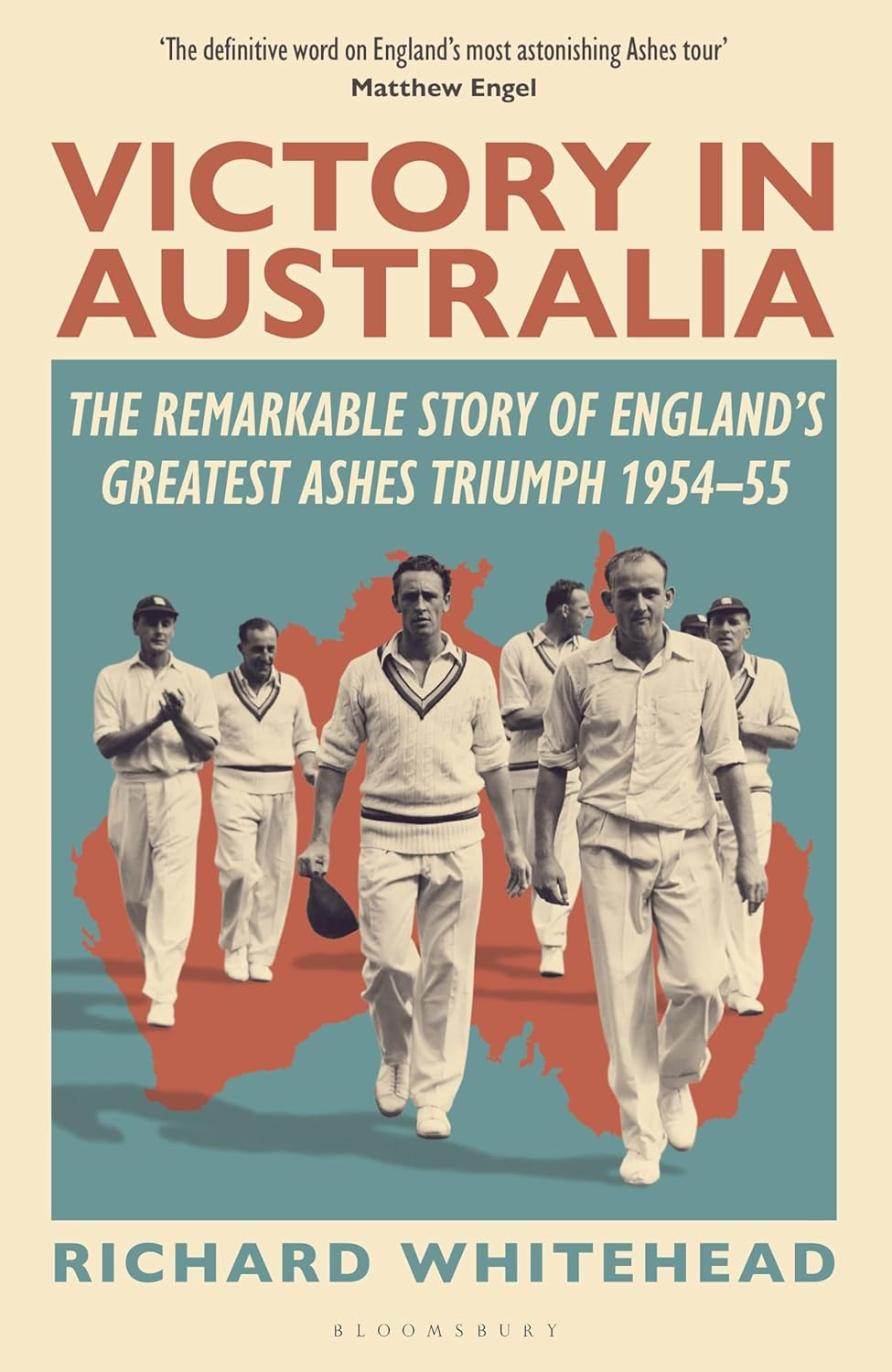
Is there no limit to Artificial Intelligence? Without even ringing the doorbell it has invaded my home and, warning that I was embarking on a very long book, pressed upon me its own summary. Had I accepted this well-meaning offer, I might not now be telling you that I have just finished reading the best cricket book in 80 years of following our great game. If this sounds an outrageous claim, I claim support from pithy dust jacket quotes from nine of our foremost writers that go far beyond publisher’s conventional puffs in lauding the book’s qualities.
Revisiting Test cricket’s greatest series is becoming a trend of the 2020s with each chosen era bringing its own challenges for the author. Those with childhood memories of the 1954-55 series unfolding must be fast approaching their eighties. How vividly I recall waking and turning on the wireless, as we would surely have called it, as fear and trepidation turned to elation in hearing that, against all odds, Tyson had ‘done it again’ to win the Melbourne Test. It is all too long ago for fresh eye-witness reports. Of the players Neil Harvey alone survives, and ten years have passed since the last three Englishmen were lost with the deaths in 2015 of Bob Appleyard, Frank Tyson and Tom Graveney. John Woodcock, to whom the book is dedicated, survived a little longer. ‘It was the shining light in John’s eyes’ Whitehead now writes, ‘when he talked about the gripping battles and this charismatic group of players that made me want to revisit the series.’
Just appointed Times cricket correspondent, Woodcock was a member of the press corps whose words are now the principal source of record with 29 different newspaper titles listed in the bibliography. Eleven tour books have been consulted and no biography, auto or otherwise, has escaped Whitehead’s probing eye. But it is how the material is marshalled that earns the book its stellar status. The author’s writing style is a joy, never striving to be just too clever and, like the conductor of a great orchestra, allowing others to take the limelight as delicious similes and metaphors flow from the pens of Alan Ross, Denzil Batchelor and many others.
From the disaster of Brisbane, where the decision at the toss might not have looked so unfortunate had a few catches been held, to recoveries against the odds at Sydney and Melbourne and the nervy sealing of the series at Adelaide the narrative keeps pace with events on the field. The impact of the weather, regularly acknowledged, adds context to the scores in a slow-scoring series. ‘I don’t know of any finer reconstruction of cricket matches than those in this book’ Scyld Berry opines.
This, of course, was a tour that conformed to the norms of the age with a mid-September departure, three weeks at sea punctuated by a one-day game at Colombo, six first-class matches before the first Test and several minor games weaved into a programme that ended with most of March spent in New Zealand. The party, moreover, carried only three non-players Geoffrey Howard, the manager, George Duckworth, score/baggage-master and Harold Dalton, masseur.
The author’s research ensures that we learn of the living conditions, the tedium of travel to many of the minor matches and the dire facilities at the end of some journeys. The book revisits several familiar controversies, sifting through differing versions of the events. It is here that the book merits a special accolade as Whitehead, always determined to get the record as straight as he can, turns his attention to such matters as the pre-tour plotting to persuade David Sheppard to interrupt his theological studies in the noble cause of ensuring an amateur captain. He explores afresh the controversy of the illicit watering of the Melbourne pitch. He ferrets through all the conflicting evidence to understand how ham-fisted was the manner in which Alec Bedser learned that he was to be omitted from the side for the Melbourne Test. He comes close to absolving Keith Andrew for his expensive miss at the start of the first Test.
The wealth of personal stories enables David Kynaston to describe the book as ‘alert to every human and social as well as cricketing nuance’. So we learn of the excitement of McConnon’s children at his selection and, later, of their father’s home sickness, the disruption of the Andrew wedding plans, the birth of Graveney’s daughter early into the tour as well as sad news of the death of Cowdrey’s father and, later, of Statham’s mother. Somehow Whitehead has discovered that Simpson was livid at the preference of Edrich as Hutton’s opening partner. Was it his love of sunbathing that set Hutton against him or his preference for playing off the back foot?
The book is full of such nuggets and it addresses the challenge of helping readers understand Hutton the man as well as Hutton the cricketer. An aura of gloom pervades as he claims he is too ill to play in the third Test and it re-emerges as England lose three early wickets in pursuit of their modest target to win the decisive Test at Adelaide. The horseplay of the Christmas celebrations finds him uncomfortable about taking part and he mutters in disbelief as Compton, Edrich and Evans set off for another night on the town.
From an electronic copy one detects a beautifully produced book, with a full index and judicious use of statistics, where I found a solitary blemish: Andrew is credited with no catches and no stumpings but one dismissal overall! I have spent a fortnight reflecting: yes, it really is the best cricket book I have ever read.