
Three giants at ease
Yorkshire’s sons before the storm

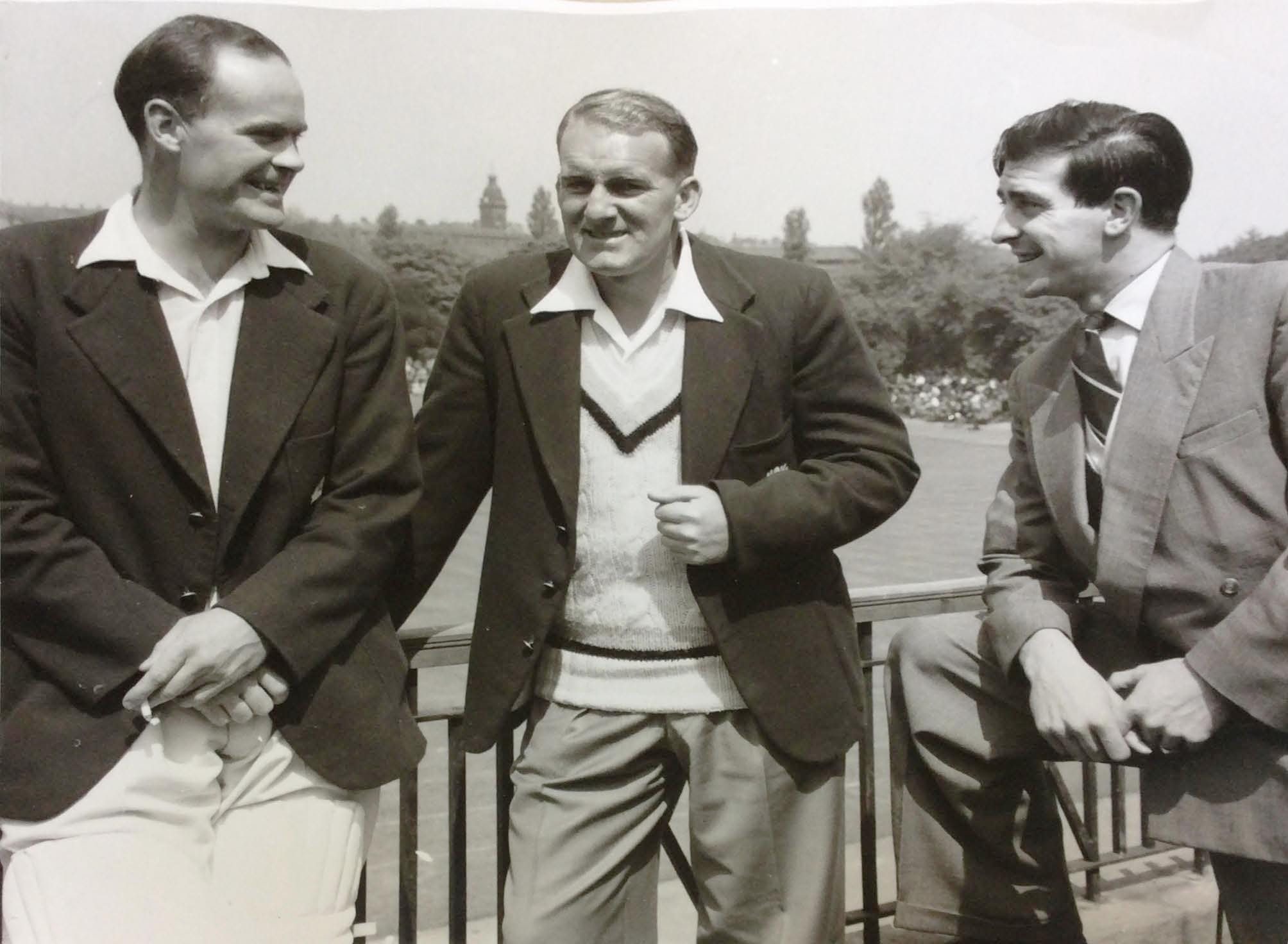
I have just acquired a photograph of rare charm and quiet drama: three Yorkshire cricketers, stood in casual congress against the pavilion railings, caught in a moment of unstudied repose. It hums with the latent energies of careers yet to unfold, of triumphs yet to be claimed, of wounds yet to be borne. Little did they know, as they stood there—discussing the pitch, the weather, the merits of playing and leaving, of bouncers and yorkers—what fate had in store for them. And perhaps it is just as well.
On the left sits Brian Close, cigarette poised between fingers with the insouciance of a man who had already defied convention. At eighteen he had become the youngest cricketer to represent both Yorkshire and England—a feat that bespeaks not merely precocity, but a temperament forged in northern grit. In 1962 he assumed the captaincy of Yorkshire, and under his stern but stirring leadership the county entered a golden era, claiming four Championship titles with a happy blend of discipline and daring. Yet, as cricket so often reminds us, glory is no shield against politics. In 1970 Close was unceremoniously dismissed—an act that wounded him more deeply than any bouncer to the ribs. He called it the worst day of his life. He meant it.
Close was not a man to fade quietly. At thirty-nine he took his bat and his principles to Somerset, where he found himself mentoring two youngsters of volcanic talent. Under his stern eye and unyielding standards, Viv Richards and Ian Botham flourished not merely as cricketers but as characters. Close retired in 1977, having played first-class cricket for twenty-eight years, including twenty-two Tests. He was, in every sense, a cricketer of the old school—tough, unyielding, never less than himself.
In the centre of the photograph is Johnny Wardle, whose left-arm spin was once the envy of every county, the despair of many a batsman. He announced himself in 1948 with 148 wickets—a harvest that made even Rhodes nod approval. By 1957 he had played twenty-eight Test Matches, and was widely regarded as one of England’s finest slow bowlers. But genius, like mystery spin, is an unpredictable thing. In 1958, after his own falling-out with Yorkshire’s committee, Wardle was dismissed. He responded with a series of scathing articles in the Daily Mail, wielding his pen with the same guile he once reserved for the ball. He went on to ply his trade in the Lancashire League, and at Cambridge.
And then, on the right, we find Fred Trueman—“Fiery Fred,” as the nation came to know him. He was fast bowling as elemental force, Yorkshire flint and thunder in human form. He debuted for the county in 1949, aged eighteen, and by 1952 had earned his England cap and the title of “Young Cricketer of the Year.” Yet even Trueman was not immune to the vagaries of selection. He was dropped after a difficult tour of the West Indies in 1953/54, and did not return to Test cricket until 1956. But when he returned, he did so with vengeance and velocity. He played 67 Tests in all, taking 307 wickets with a snarl and a swagger, until his retirement in 1965.
The highlight of his career, he once said, was in 1968, when he captained Yorkshire against the touring Australians at Bramall Lane, and Yorkshire triumphed by an innings and 69 runs—a victory that bore the stamp of his own indomitable will. He retired that year, but cricket never quite retired from him. In 1972, after three years away from the first-class game, he joined Derbyshire, extending his presence on the circuit like the lingering echo of a thunderclap.
And so they sit—Close, Wardle, Trueman—three men at ease, unaware of the storms and the sunlit days ahead. Their expressions are untroubled, their futures unwritten. Thank goodness: Cricket, like life, is best lived without foreknowledge. Hindsight, in contrast, enriches it. The photograph remains: a still moment before the innings begins.
 | A guest post by
|