
The First Ball After Lunch
ACS Book of the Week

Each week we spotlight a fascinating title from the vast collection catalogued in the Cricket Bibliography project, drawing on insightful (but not necessarily positive!) reviews from the archives of our journal. Today we bring you The First Ball After Lunch (2024) by John Benaud, reviewed by Richard Lawrence.
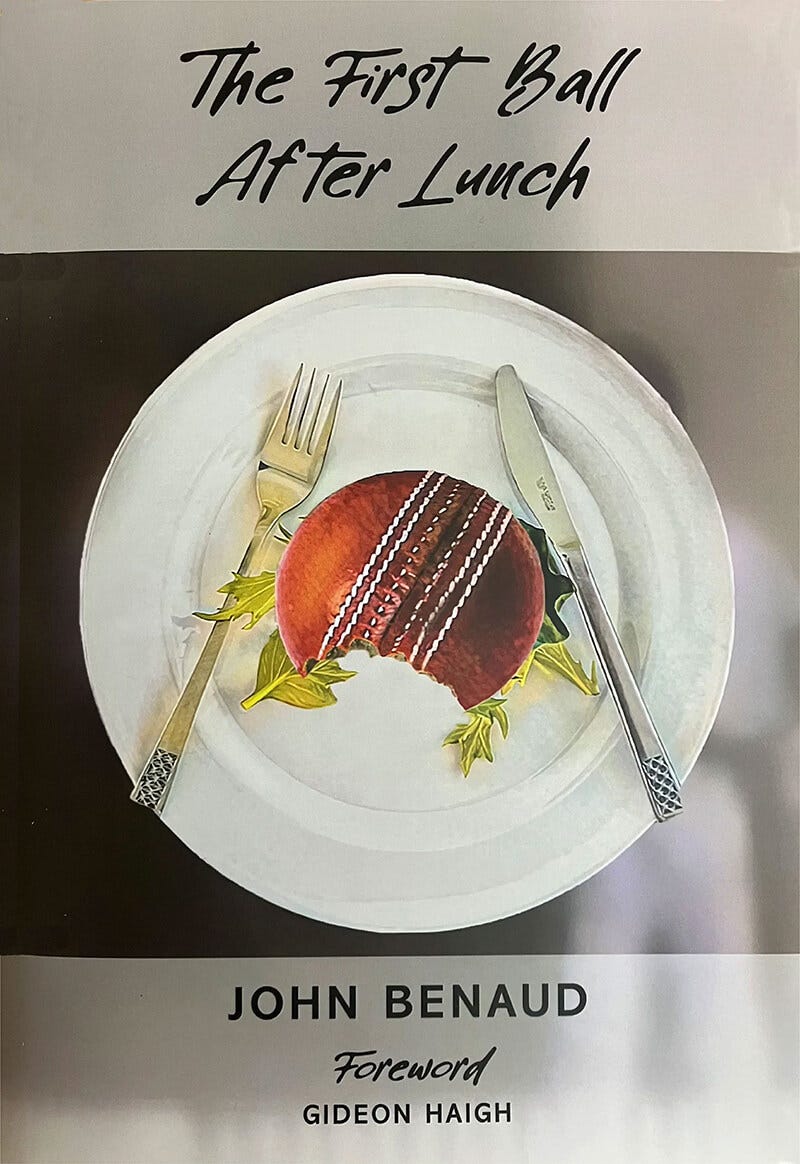
Despite some exciting, high-quality cricket, and a victory for Australia that was the last in the Caribbean until the mighty West Indies side of the 1970s and 1980s began to decline, the 1973 Australian tour of the West Indies does not seem to be a series that has lived in the collective memory of cricket historians. In this account, part tour diary, part historical reflection, John Benaud, who was in the tour party although he did not play in the crucial third Test which gives the book its name, sets the record straight. Looking back on the tour after more than fifty years, he sees in its events many of the characteristics and ingredients that were to define cricket over the next twenty years.
The series came to life in the third Test, where as the name suggests the first ball after lunch on the final day brought a wicket that turned both the match and the series. The Australian tourists were nicknamed ‘the Desperates’, a term that refers not so much to the quality of the side as to their ability to fight their way out of trouble. The leadership of Ian Chappell (not always the most popular Australian cricketer on this side of the world) is key here, both in the team spirit he engendered and in his ability to read the game and deliver the right tactics for the situation he faced. John Benaud’s account of the key matches in the series succinctly but masterfully captures the development of the play. In a retrospective, he also explores key aspects of the tour such as the injury to Dennis Lillee, which was to have far-reaching consequences, and the reaction to which shows the Board in a very poor light.
The last part of the book is a reflection on how the game changed in the years following the tour. Many of the tourists were later to become core members of the Packer Australian XI, and the terms and conditions under which the tourists played in 1973 give context to that later conflict, as indeed does the loyalty inspired by Ian Chappell. The fact that two key players, Paul Sheahan and Ashley Mallett, were unable to tour because of other commitments, is a further illustration of this – although had they done so, John Benaud would almost certainly not have made the side and we should have been deprived of this book. The West Indies selectors are seen to have missed a trick in overlooking the young Michael Holding, who had caused Ian Redpath multiple problems, and opting instead for Raphick Jumadeen. The seeds of the decision to pack the West Indies side with quality pace bowlers later in the 1970s can be seen in the spinners’ disappointing impact, not only in the series against India a few years later, but as far back as early 1973.
Beautifully produced on good paper, the book has production values to match the quality of the writing. In addition to the main edition another limited edition has also been produced, signed by all the surviving members of the team including the late Keith Stackpole, who signed not long before his death in April 2025.