
The Dream That Died
ACS Book of the Week

Each week we spotlight a fascinating title from the vast collection catalogued in the Cricket Bibliography project, drawing on insightful (but not necessarily positive!) reviews from the archives of our journal. Today we bring you Andrew Hignell’s The Dream That Died: Gwilym Rowland and Welsh Cricket (2024), reviewed by Richard Lawrence.
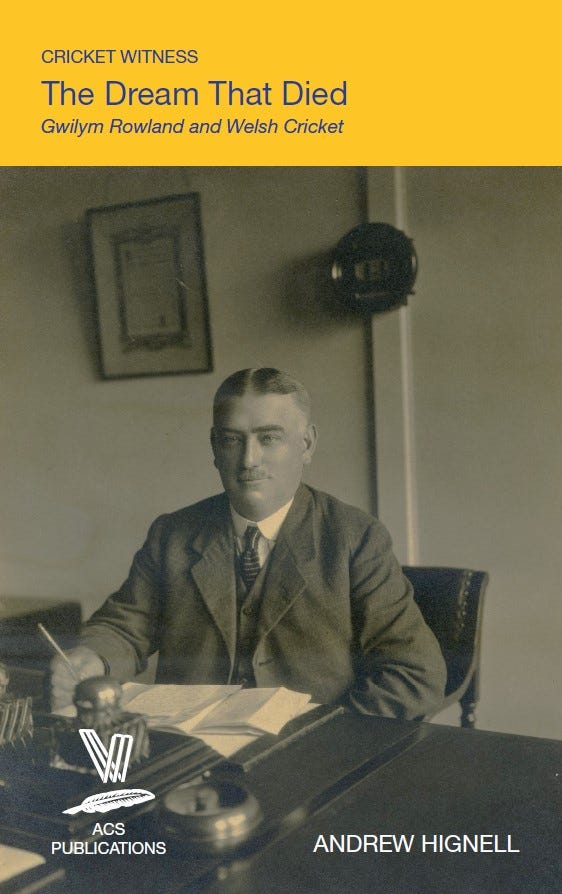
For his latest venture into Welsh cricket history, Andrew Hignell looks at the life and legacy of Gwilym Rowland, a businessman and philanthropist who in the 1920s and 1930s did much to promote cricket in North Wales and indeed, building on the vision of those who first conceived the notion of a county cricket club in Glamorgan, the concept of a Welsh national side. His dream took various forms. As well as the national side – which sometimes brought him into conflict with the Glamorgan officials when he wished to secure the services of county players for Wales matches – he also promoted an amateur Welsh side, the Cygnets (in tribute to his friend Henry Swan) in the hope of developing amateur talent in the Principality, and county cricket in North Wales. The sad story of the fleeting entry of Denbighshire into the Minor Counties Championship in the early 1930s is a fascinating sub-plot, as indeed is the account of the visit of a German side to play club cricket in England in 1930 (a strand which has a dark postscript).
Yet it all ended in tragedy. How this successful entrepreneur ended his life in a ditch in Anglesey is the subject of the last section of the book. Rowland would appear to have over-reached himself in his business dealings, and some responsibility for the collapse of the conglomerate he headed seems inescapable. He lost his home and at the end of his life was living with his wife in rented accommodation in Anglesey.
By this stage, his dream of Wales becoming a Test nation had indeed died, and indeed without his financial support there were no further Wales matches after 1930. There is rich irony in the fact that although Wales now stages Tests, it hosts England. As this review was being written, the Six Nations was in full swing, and it is extraordinary to reflect that while for rugby the concept is firmly established within the varying national consciousness of these islands, some hundred years after Rowland was in his heyday, no such competition appears to have been seriously considered in cricket.
 | A guest post by
|