
Stroke of Genius
Victor Trumper and the Shot that Changed Cricket

We’re delighted to share with our readers an exclusive deal with Pitch Magazine for their bumper Ashes issue, which has just hit the shelves. Use the code ASHES20 at checkout to get 20% off!
Each week we spotlight a fascinating title from the vast collection catalogued in the Cricket Bibliography project, drawing on insightful (but not necessarily positive!) reviews from the archives of our journal. Today we bring you Stroke of Genius (2016) by Gideon Haigh.
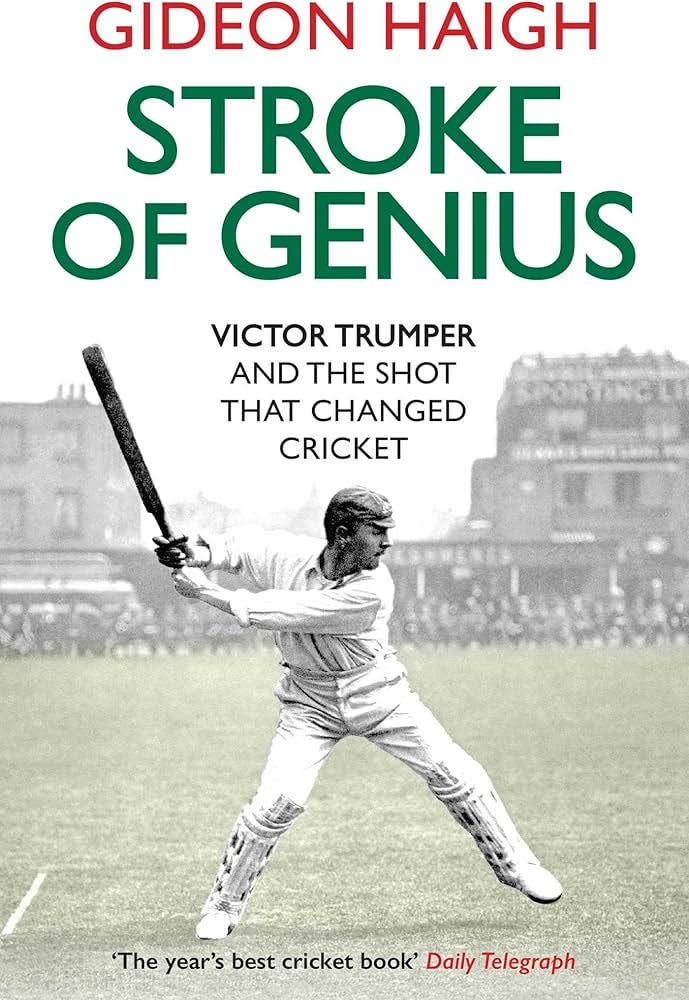
This is a book that defies conventional labels. It is certainly not a biography of Trumper. Three eminent writers have already attempted this - Jack Fingleton, Ashley Mallett, Peter Sharpham - without, it has to be said, entirely satisfactory results. Such is the mythology that has grown up around Trumper, and the lack of reliable first-hand source material, that a successful biography, free of either hagiography or iconoclasm, becomes extremely difficult.
Haigh himself describes the book as an ‘iconography’, taking as its focus the photograph by George Beldam that beyond all others epitomises Trumper. It is in part an account of the growth of cricket photography which led to the session at The Oval in 1905 when the famous picture was taken, and the book in which it first appeared, Great Batsmen: Their Methods at a Glance, in which Beldam’s pictures were accompanied by text by C.B.Fry. Tellingly, Fry’s somewhat expansive and sometimes dense prose was greatly condensed when he wrote on Trumper, as if the images needed no explanation. Haigh analyses the pictures and their context in considerable detail, which serves to underline the enormity of the achievement and photography’s status as an art form.
He further traces the development of the image of Trumper after the great batsman’s death. It was some years later, in October 1927, that the image received its first outing beyond Beldam’s book, when it appeared as a half-page feature in the Sydney Daily Mail. Haigh’s shows how it developed into an icon, its impact strengthened by the devotion Trumper inspired from the outset. While the misty-eyed adulation of the period before the First World War as cricket’s golden age developed only gradually, and more or less in parallel with the growth of the picture’s status, the sense that there was something special about Trumper was there from the start, although time has glossed over some aspects of his life.
But the book is also about Trumper: it could hardly be otherwise. Much of his early life remains a mystery which may never now be solved, which should certainly act as a deterrent to future biographers. Popular belief portrays Trumper rising above sordid financial motivations and free of self-conceit. Without attempting to explode the myth, Haigh is nonetheless keen to explore beneath the surface. Generous and modest Trumper may have been, yet he knew his own worth and it was no accident that he was one of the ‘Big Six’ who took on the self-appointed Australian cricket establishment in the early part of the twentieth century. Trumper is not discredited by Haigh’s analysis, but he does emerge as a more human character. His role in the establishment of rugby league in Australia, and his subsequent dismissal from his position as the new sport’s treasurer, underline that he was a man prepared to take on self-appointed elites, and also confirm that he was not a wise man when it came to handing finance. Haigh remarks laconically that Trumper’s reputation was ‘not enhanced’ by his involvement in the venture.
For all the improvements in photographic technology and technique over the last century, Beldam’s image of Trumper remains a peculiarly compelling one, underlined by the fact that attempts to replicate the stroke by more modern players such as Dean Jones and Belinda Clark somehow don’t quite come off. Gideon Haigh’s masterly account of the image and the story behind it helps to understand what it is about the image that is so outstanding. A special book about a special picture.