
Something Changed
Beefy, Boadicea, Brixton, Bunting and How Cricket Changed the Nation

Each week we spotlight a fascinating title from the vast collection catalogued in the Cricket Bibliography project, drawing on insightful (but not necessarily positive!) reviews from the archives of our journal. Today we bring you Something Changed: Beefy, Boadicea, Brixton, Bunting and How Cricket Helped Change the Nation (2025) by Ben Dobson, reviewed for us by Douglas Miller.
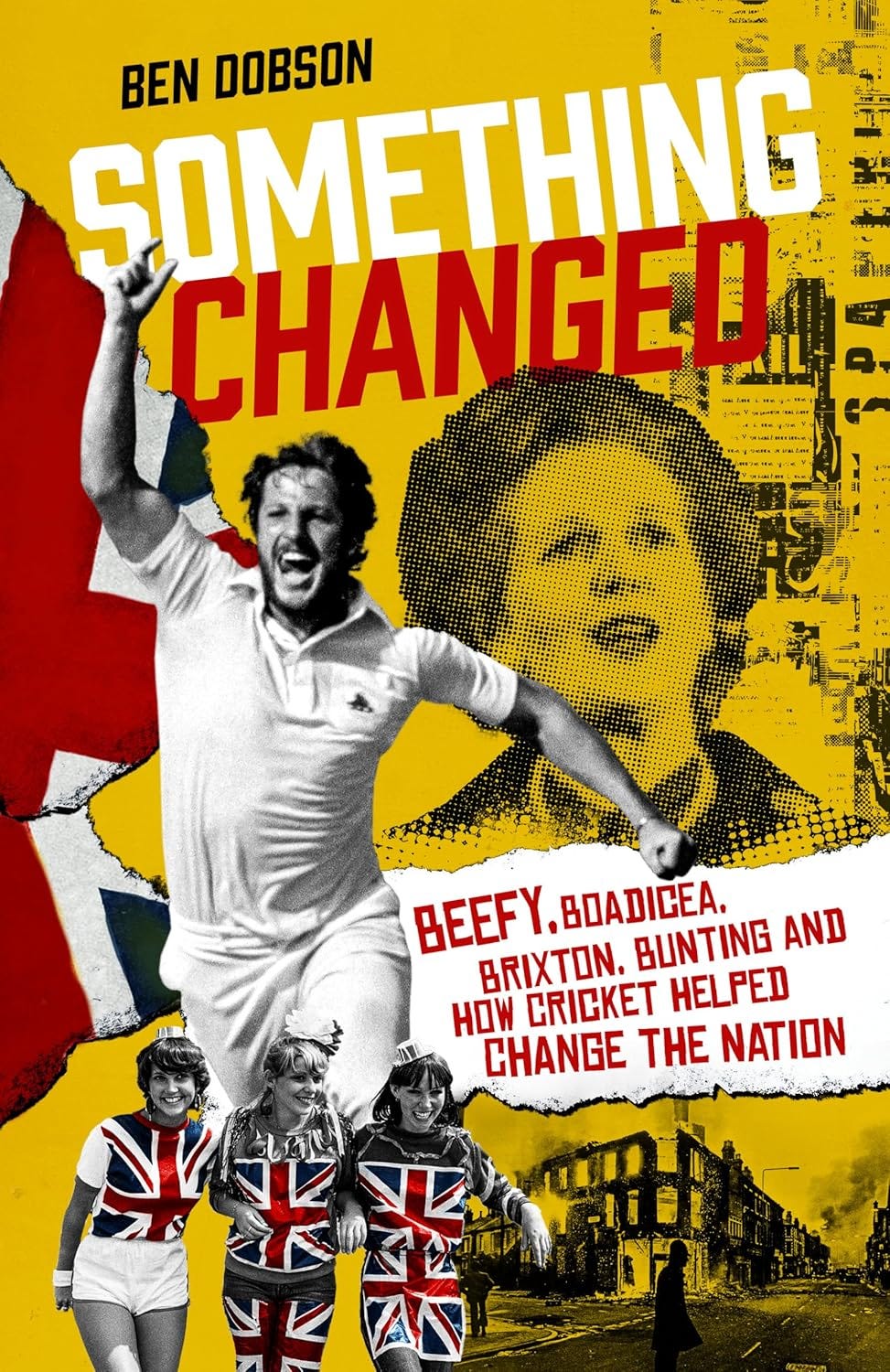
Make no mistake: this is a very good book. But is it really a cricket book? In asking the question I hesitate to recommend it to anyone seeking to read primarily about cricket. I also question, for instance, whether it qualifies as a potential Cricket Book of the Year. I would say no, but I was at odds with the judging panel in saying the same of Half of the Human Race, a highly regarded novel in which the handling of the cricket that formed the background to the story was its greatest weakness.
Ben Dobson is an accomplished and stylish writer who has set himself a daunting task. ‘Please not another “Botham’s Ashes”…’ was his own sentiment as he set about the challenge of tracking the nation’s mood in and around the heady days of the early 1980s. Dobson’s thesis is that there was an uncanny similarity in the fortunes of Ian Botham and Margaret Thatcher as the decade opened. Reminding us also of the weather in those summers, of the royal events, of other sporting highlights (Coe and Ovett winning Olympic gold) and even of pop songs of the time, he suggests that these different factors synchronised in defining how we all felt.
Almost to my surprise I found the book works: its thesis is largely valid. ‘By the end of 1976 the country and its cricket team were united in a spiral of decline and depression,’ Dobson reminds us. Then came Botham and Thatcher, but neither enjoyed untrammelled success. As Botham traipsed in silence from the field at Lord’s in 1981 his star was all but extinguished. Thatcher, meanwhile, had plumbed the depths with a budget that refused to pander to short-term discontent. She had to wait longer than Botham to see the corner turned, but in 1982 the continuing brilliance of Botham was matched by Thatcher holding her nerve in her decision to resist the Argentinian claim to the Falklands.
Statistics are sometimes quoted with trade figures set against Botham’s batting and bowling averages. But all good things come to an end. A short appendix of statistics shows that in his last 14 Tests Botham averaged 20.5 with the bat and 57.5 with the ball. He still believed in himself – that is the way he is made – but his misguided belief was matched by Thatcher clinging to power as even her most trusted supporters had to tell her that her time was up.
There are a few more literals than in the best Pitch books and it is unfortunate that Dobson’s most widely quoted historian of the period, Dominic Sandbrook, is referred to as Duncan on the second page of text. Strangely for one whose reading is not extensive, Sandbrook’sWho Dares Wins, covering the early Thatcher years, is familiar as a masterly dissection of the Iron Lady’s early achievements. So, accepting that the merit of Something Changed lies more in Whitehall than on the cricket field, why not go straight to Sandbrook? This was an early instinct, but it made way for increasing admiration of Dobson’s research and his grip on the complexities of government where there are fewer scorecards to consult. If the politics of the period enthral you, this is a book not to be discarded; but if your only interest is cricket – and C.L.R. James would think less of you for that – then forget it. You will not learn much that is new about Botham.