
Scarborough 1936
Brian Sanderson on Shack’s photographs, Hirst’s wanderings, and Sutcliffe’s redemption

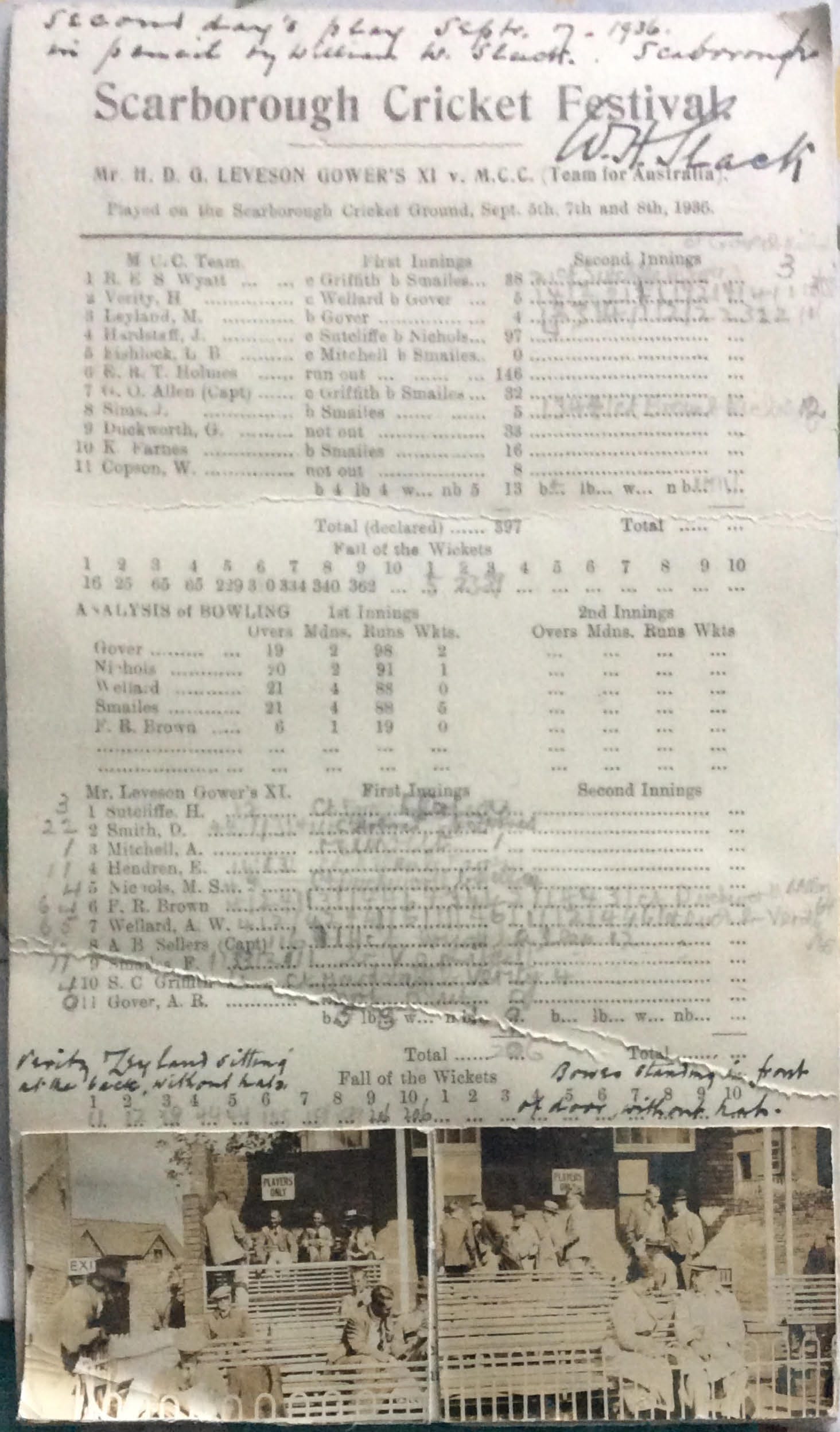
I have lately come into possession of a scorecard of the match between HDG Leveson-Gower’s XI and the MCC at Scarborough, played in September 1936. The Marylebone men were no ordinary assembly, but the team destined to sail for Australia that winter, charged with the burden of reclaiming the Ashes. Thus the match, though ostensibly a festival encounter by the sea, had the aura of an important rehearsal.
MCC batted first, and on a Saturday bathed in sunshine, compiled 397 for nine before a crowd of ten thousand. Scarborough, with its salt air and its pavilion perched like a theatre box above the stage, was alive with expectancy. The scorecard itself bears witness to more than numbers: Mr Shack, a devotee of the game, attended on the Monday and adorned it with photographs of the players—Verity, Leyland, Bowes—standing in casual camaraderie outside the pavilion’s changing rooms. These images, pasted lovingly, transform a bland scorecard into a sacred relic of memory.
It rained on the Sunday, and continued relentless until ten on Monday morning, so that play could not begin until one o’clock. In the meantime George Hirst, titan of the county’s golden age, was seen wandering the ground. It was his sixty-fifth birthday. One imagines him greeted with reverence, a patriarch among his people, the years having softened but not diminished the aura of a man who once bestrode the field like a colossus.
Guppy Allen, captain of the MCC, declared on the overnight score. The sun returned with brilliance, yet the north-west wind blew half a gale, and only five thousand hardy souls braved the elements. Herbert Sutcliffe, back from injury, opened with Denis Smith of Derbyshire. But fate was cruel: In the second over Sutcliffe turned Copson to Farnes at short leg, and soon after Mitchell perished in a run-out, undone by the lightning quickness of Duckworth. The innings faltered like a ship struck broadside.
Hope flickered with Hendren’s arrival, but Smith was caught at short leg, and Nichols essayed a single glorious cover drive before succumbing at slip. Then Hendren himself fell to Allen. By lunch, five wickets were down for a paltry 55. The Scarborough crowd, accustomed to festival gaiety, watched in sombre silence.
At length a reprieve, as Brown and Wellard stitched together a partnership of 111, bringing some warmth to the afternoon. Leveson-Gower’s XI were all for 206 in 38 overs. MCC, in their second innings, reached 98 for three at close of play, with Leyland and Hardstaff still at the crease.
The third day, missed by Mr Shack’s camera, brought Sutcliffe’s redemption: a century wrought with all the old mastery, each stroke a reminder of his place among the immortals. Thanks to it, and to him, the match ended in a draw. The spectators, insatiable, were granted another feast the following day, when the touring Indians took on the MCC.
This scorecard joins my collection of Scarborough relics—a palimpsest of sunshine and rain, of Hirst’s birthday wanderings, of Shack’s photographs, of Sutcliffe’s redemption. It is Scarborough itself, with its mingling of sea breezes and cricketing destiny, preserved in miniature.