
Rain!
100 Years Ago: 22-28 July 1925

Day 1
Southend-on-Sea Festival: Essex v Kent
The pitch was fast, but there seemed to be nothing seriously wrong with it, so the failures of the batsmen of both sides were really inexplicable. Essex struggled for runs early on against very good Kent bowling, with only Jack Russell showing much in the way of form. Percy Perrin also batted usefully to try to hold the middle order together, being the ninth man out, and they were the only batsmen all day to score more than 20. Charlie Wright and Tich Freeman both took good hauls and quite dominated the batsmen.
157 was no great score, but Kent fared much worse in the hour for which they batted. With George Louden unavailable, Stan Nichols and Johnny Douglas opened the bowling and quickly had Kent in deep trouble. Wally Hardinge battled on while wickets fell steadily at the other end, and then he too was out, lbw to Douglas, just before the close for 10. By the early close due to bad light, he was the only man on the side to have scored more than 3 runs, although he was outscored by Extras with 14.
Bristol: Gloucestershire v Derbyshire
After heavy overnight rain the match began on a pitch soft on top but firm underneath, and Colonel Douglas Robinson wisely put Derbyshire in to bat. Garnet Lee was dropped by Percy Mills in the gully off the first ball of the match, from Wally Hammond, but Mills made up for it soon after by holding a brilliant catch to remove Lee for 10. The score reached 37 before the third wicket fell, and disaster followed. George Dennett took three wickets in an over, and in fact five successive batsmen in the order failed to score as the score became 39 for eight. Guy Jackson survived the carnage, though, and with the pitch easing after lunch he hit out boldly with Jim Horsley at the other end, taking the score to 81 in two hours in the end. Charlie Parker removed them both as he bowled throughout the innings to take five for 19.
Gloucestershire began their innings cautiously, but Derbyshire do not have a spin bowler capable of taking advantage of the conditions, so the runs came, although scoring was not easy. Robinson batted well, losing Alf Dipper for 11, and they passed the Derbyshire score with three wickets down. Afterwards Hammond and Bernie Bloodworth began to attack the bowling more successfully, until Hammond was bowled for 41 attempting a rash hot, as he too often does. But Gloucestershire were able to finish the day in a strong position.
Manchester: Lancashire v Glamorgan
Glamorgan would have had a wonderful day at Old Trafford had it not been spoiled for them by the acting Lancashire captain, John Barnes. In the first half-hour Lancashire lost their first five wickets for 28 runs to the bowling of Helm Spencer, a former Lancastrian, supported by Trevor Arnott, although neither found any real help from the good pitch; they simply bowled with persistent enthusiasm and accuracy, Spencer working up some pace and Arnott using a crosswind well. Glamorgan were bowling and fielding with great verve. But Barnes stayed in, batting cautiously, and with a little help from the middle order the score was raised to 91 for seven.
Then the young Frank Sibbles at last provided Barnes with a reliable partner and they added 84 for the eighth wicket. Ted McDonald also stayed in for a while to enable Barnes to reach his excellent century, before he was finally out to Arnott with the second new ball after scoring an excellent 103 in about three hours. With McDonald and Cecil Parkin hitting out to put on 29 in eight minutes for the last wicket, Lancashire reached 241. Frank Ryan, in such fine form recently, bowled tidily today but without a wicket.
This same pair then made Glamorgan struggle with their fine bowling, but Tom Abel batted well for 36 and Emrys Davies showed good defence for 16 before three wickets went down in the eighties to make the score 83 for six. Johnnie Clay countered with some aggressive hitting before the close, when Glamorgan were still not out of the woods with six wickets down and still less than half of Lancashire’s score.
Lord’s: Middlesex v Hampshire
Overnight rain had made the pitch at Lord’s rather awkward, but very slow in pace, so batting was not impossible for the careful. Hampshire reached 71 with their openers out, but then Ronnie Aird and Phil Mead both fell on this score immediately before lunch — all four batsmen were out lbw. Afterwards Alex Bowell and Lionel Tennyson fought back with a partnership of 83, although Tennyson was fortunate to be dropped at 13 at deep square leg. After this he showed much more restraint than usual before they were both out in quick succession, to brilliant catches by Patsy Hendren and Ben Sherwell, the latter making his début for Middlesex. Their main enemy was the apparently tireless Nigel Haig, who swung the ball beautiful and dismissed both these batsmen and the next two in quick succession. Jack Hearne also bowled well, with good spin and variations of pace. Alec Kennedy handled them skilfully later in the innings. There was little play after tea due to rain and later bad light.
Kettering: Northamptonshire v Yorkshire
It was a hot day after overnight rain and the soft, damp pitch did not play very easily, though Northamptonshire chose to bat first. Their policy appeared to be grim defence and not much more. In an hour and a half before lunch only 34 runs were scored for the loss of Claud Woolley’s wicket, and five wickets were down for 47. Wilfrid Timms, opening the innings, scored 11 runs in 100 minutes. Only Ben Bellamy made much effort to attack; hardly surprisingly, he ended up as the top scorer, with five fours in his 23. The whole innings lasted 73.2 overs and 3¼ hours for 107 runs, about 1½ runs per over.
Yorkshire lost Herbert Sutcliffe, caught at slip off Philip Wright without scoring, in the second over. Percy Holmes survived a chance at 17, and Yorkshire took the lead with only two wickets down. Edgar Oldroyd played as soundly as usual, while Maurice Leyland had a very bright innings, scoring 41 in 40 minutes with eight fours. Yorkshire are playing at Kettering for the first time, and aroused great local interest, with a crowd of about 5000 in attendance, much larger than is normal for Yorkshire matches at Northampton.
Weston-super-Mare Festival: Somerset v Worcestershire
A thunderstorm last night had soaked the ground and play could not begin until 2.30. Worcestershire won the toss and put Somerset in to bat, thinking the pitch would suit the bowlers, but in fact it played easily. Two early wickets from Fred Root did have Somerset in some trouble with only 34 runs on the board, but then Jack White joined Archie Young and they added 82 runs for the third wicket before White was run out, just before tea. Root continued to bowl well, but without much luck. During the innings another thunderstorm arrived, which lasted for only about a quarter of an hour, but was so heavy that no further play was possible today. Young was still there, batting steadily with 63 in the two hours possible.
Hove: Sussex v Surrey
Afternoon rain badly interfered with the play today. There was a particularly large crowd today, apparently in the hope of seeing Jack Hobbs score his 126th century to equal W G Grace’s record, but if so Maurice Tate spoiled it for them. In his second over he deceived Hobbs with a ball that the batsmen expected to swerve, but instead came straight through and trapped him lbw for just a single. Andy Sandham was out just after lunch for 32 to a fine catch at backward point by Jim Parks, who is getting a reputation as a brilliant fielder, but Andy Ducat played a fine innings, scoring mainly on the leg side. He was approaching his century when more rain finally ended play at 4.30. In a badly interrupted afternoon Tate for the third time took a wicket in the second over of a spell, having Tom Shepherd caught at the wicket. Only three hours’ play was possible altogether.
Day 2
Southend-on-Sea Festival: Essex v Kent
There was a heavy thunderstorm, followed by more rain, last night, and the ground was so saturated that no play was possible all day.
Bristol: Gloucestershire v Derbyshire
Gloucestershire’s overnight pair of Bernie Bloodworth and Robert Melsome produced the most attractive batting of the match as they took their partnership to 69 before Bloodworth, the more aggressive of the two, was out. He was to be the only batsman to score a fifty in the match. Gloucestershire eventually earned themselves a lead of 174 on the first innings, as Jim Horsley took four of their last five wickets to fall for just 12 runs.
The pitch had been damp but fairly easy early on, but it was becoming more awkward as the sun came out and Derbyshire went in for their second innings. Three wickets were down for 28 at lunch, and afterwards the left-arm spinners Charlie Parker and George Dennett steadily worked their way through the middle order. They had eight wickets down for 92 before the only two batsmen to pass 20, Escott Loney and Horsley, put on 42 for the ninth wicket, but they could not save the innings defeat. Parker finished with match figures of 11 wickets for 80 runs.
Manchester: Lancashire v Glamorgan
Johnnie Clay was soon out this morning, but Trevor Arnott made some good aggressive strokes before Glamorgan completed their first innings for 166, a deficit of 75. Despite their lead, Lancashire made a cautious start to their second innings, which was rather forgettable until Frank Watson got going. He played soundly on his way to a century in about three hours, apart from offering two chances, but never tried to force the pace. He found no major partnerships, although the debutant Tom Halliday scored a dogged 17 in a fifth wicket partnership of 63 in 50 minutes. John Barnes this time took half an hour to score 8. Ted McDonald was the most entertaining batsman, hitting 27 in a quarter of an hour, but most of the batting had been rather laborious, although the Glamorgan bowling and fielding made them fight for their runs. Frank Ryan tied down the batsmen with his accurate bowling until McDonald attacked him and spoiled his figures.
Lancashire declared just before the close, setting Glamorgan 361 to win, but could not take a wicket tonight, as the Glamorgan opening pair safely batted through the 22 minutes they had before the close, in bad light against some fine bowling from Cecil Parkin and McDonald. Despite their deficit, Glamorgan gained more applause from the home crowd and critics for their positive, enthusiastic approach to the game than did Lancashire for their dogged accumulation.
Lord’s: Middlesex v Hampshire
There was so much rain overnight that the pitch and the surrounding area were completely sodden, made worse when there were further showers during the day.
Kettering: Northamptonshire v Yorkshire
More rain prevented play until after two o’clock today, and far from helping the Northamptonshire bowlers, the wet conditions made it difficult for the bowlers to get a foothold. They could get no help from the lifeless pitch either. It was soon clear that Yorkshire had set their minds on a day off tomorrow. The overnight pair of Edgar Oldroyd and Wilfred Rhodes got after the bowling quickly and added 110 runs in partnership. Oldroyd reached his century, his first of the season after a lean spell. Soon afterwards Yorkshire, seeing the pitch was drying and becoming more difficult for batsmen, declared with a lead of 152.
Then George Macaulay and Roy Kilner got stuck into the hapless Northamptonshire batsmen on the drying pitch. Wilfrid Timms was first man out for 5 with the score at 6, which started an avalanche, seven wickets going down by the time the score had reached 15. At tea the score had improved enough to reach 22 for seven wickets, with Richard Wright still there. Wright and John Murdin continued after the interval with the major partnership of the Northamptonshire innings, all of 23 runs for the eighth wicket. Wright batted for 50 minutes and scored 20, almost half the total; next best were Timms and Murdin with 5 each. Timms was the only batsman to be caught in the innings; Murdin was lbw, and the other eight batsmen dismissed were all bowled out, Macaulay taking six wickets and Kilner four and bowling throughout the innings. The whole innings lasted only 70 minutes and Yorkshire got their day off, while Northamptonshire had a very off day.
Weston-super-Mare Festival: Somerset v Worcestershire
The pitch was still quite easy at Weston-super-Mare, but it was hard to get the batsmen to believe it. No batsman scored more than 27 runs on it today, which the overnight batsman Archie Young did today. He was dropped three times in the process before being finally out to a brilliant running catch on the leg boundary by Cliff Wilson. Young and Root largely dominated the Somerset innings, the latter finishing with eight wickets through very fine bowling.
Worcestershire lacked a Young to hold their innings together. Jack White was the main bowler this time, and although four batsmen passed 20, not one could reach 30. Maurice Foster, the captain, played the best of these innings with a typically aggressive 27, but he was out to an excellent catch by George Hunt. Worcestershire fell 59 runs behind on the first innings, and Somerset were able to make a start to their second innings for 20 minutes before the close without losing a wicket.
Hove: Sussex v Surrey
As he showed in the last match, Arthur Gilligan can lift the Sussex team by his inspiring leadership and presence on the field, but without his bowling the side is still not strong. Instead, it was the Surrey captain Percy Fender who rather dominated the day’s play. The early stoppage for rain yesterday perhaps deprived Andy Ducat of a century, for after being 85 not out overnight he was soon out this morning. His partner Miles Howell scored a very fortunate fifty, for he was unusually missed in the field three times by Sussex, whose ground fielding was superb. The Surrey innings was galvanized by Fender, who attacked the bowling brilliantly after lunch, winning a fine battle with Maurice Tate, for whom the pitch was rather too slow. At one stage Fender hit 24 in an over from Tate, with two sixes and three fours. He was unbeaten with 80 in an hour and a quarter when the innings closed for 343. The cunning slows of George Cox actually troubled Surrey more than Tate today, but he had little luck.
Sussex struggled when they went in, losing their first five wickets for 83, four of them to the bowling of Fender and a run-out of Ted Bowley by Jack Hobbs for 16. Then Arthur Gilligan joined John Naumann and the pair decided to attack, which quickly proved the best policy. They put on 59 for the sixth wicket in 40 minutes before Gilligan skyed a catch. Naumann hit a fine fifty, but was out at a critical time in the last over of the day when Sussex were only five runs short of saving the follow-on. The last two batsmen will have to do this tomorrow, as it could make the difference between a draw and a defeat for Sussex.
Day 3
Southend-on-Sea Festival: Essex v Kent
It was most unfortunate, especially for Essex, that the weather ruined the match between two close rivals in the championship table. More night rain further soaked the pitch, and it was remarkable that play was possible at half-past two. The pitch was still very soft and batting was not easy. It took only a quarter of an hour for Essex to take the last four Kent wickets, three of them to Laurie Eastman in 13 balls, and bowl them out for only 43, thus taking a first-innings lead of 114.
Essex went in again and did their best to make runs quickly, with Frank Woolley and Tich Freeman the only bowlers used, but it was not easy and they lost five wickets in scoring only 64 runs, a lead of 178. With an hour and 40 minutes only left it was a very conservative declaration. Wally Hardinge was bowled for a single in the first over, but Con Johnstone and Bill Ashdown dug in, Ashdown showing such grim resolve that he was still there with 2 not out after an hour. At this point Claude Ashton bowled Johnstone, but Johnny Douglas decided that they had no hope of winning the match now and the match was given up as a draw.
Manchester: Lancashire v Glamorgan
Glamorgan showed plenty of spirit and made Lancashire work hard to beat them today. Cyril Walters and Tom Abel made a steady opening partnership of 41 before Ted McDonald produced a superb off-cutter that hit Walters’ off stump. Four wickets were down for 93, but Dai Davies played an excellent fluent innings of 72 in only about 85 minutes, which included 11 fours. This included the best partnership, one of 69 for the eighth wicket with Helm Spencer. It took another superb delivery from McDonald, a vicious breakback, to bowl out Davies in the end. Nine of the Glamorgan batsmen reached double figures, but only four of them reached 20. McDonald took seven wickets, a good return to form, as he has not been bowling up to his usual top standard recently.
Glamorgan went down with honour today and their spirit was much appreciated by the home crowd. They particularly showed up Lancashire in the field, with Dai Davies always brilliant in the covers. Harry Makepeace is Lancashire’s best fielder and always does a fine job, but the likes of Cecil Parkin and McDonald seem to take their time in the field as a quiet rest when they are not bowling.
Lord’s: Middlesex v Hampshire
This match ended in farcical circumstances as Middlesex successfully rejected runs so as to avoid a first-innings result that would have reduced their percentage in the County Championship table. The fault however lies in the points system, for it is clearly unfair that such a situation should arise.
After play started half an hour late, it took Middlesex ten minutes to get the last Hampshire wicket — perhaps they weren’t trying — and then Middlesex had most of the day to play out without being dismissed, since an outright victory for them was out of the question. Hampshire were not complicit in their plan, as a first-innings lead for them would have earned them three points out of five, so they were striving for wickets, while Middlesex had to stay at the wickets without making enough runs to catch the Hampshire total. They lost their opening batsmen for 7 runs — a first-innings defeat would be even more disastrous — but Jack Hearne and Patsy Hendren put on 78 together. Hendren batted for 2¾ hours and Frank Mann for 2¼, and it must have been frustrating to him as well as the spectators to pat back full tosses and half-volleys to make sure Middlesex didn’t overtake the Hampshire total by mistake.
Weston-super-Mare Festival: Somerset v Worcestershire
The Somerset second innings was not very impressive this morning until the sixth wicket fell at 111. Jack White was still there, batting well, and he was now joined by Bill Greswell, who attacked the bowling to hit 46 in 40 minutes. The partnership was worth 78 and when Greswell was out White deemed it safe to declare, setting Worcestershire to score 249 to win in just under three hours.
It was quite a conservative declaration, given the unreliable Worcestershire batting and the fact that it would be the highest total of the match, but Maurice Foster intended to make an attempt at it, as shown when he went in to open the batting with Dick Pearson. After he was out for 16, the chase continued for a while, but wickets began to fall, although Pearson played a fine innings for 37. But Somerset had not enough time to win the match.
Hove: Sussex v Surrey
The fate of this match was virtually decided in the first few minutes, when Sussex went in with one wicket left and 5 runs needed to avoid the follow-on. Without a run added Percy Fender had Bert Wensley caught by Bert Strudwick at the wicket, and Sussex were doomed.
The pitch was more helpful to the bowlers today, and it especially suited Alan Peach, bowling fast-medium from the top end of the ground. He quickly dismissed Jim Parks without scoring, brilliantly caught by Strudwick on the leg side, and then caused Ted Bowley to play on for 4. More wickets tumbled, and seven hapless Sussex batsmen were out with only 30 runs on the board, Peach having taken five of them. However, Arthur Gilligan showed some fight, and he managed to inspire two partners to stay in with him to save Sussex from complete humiliation. Colonel Arthur Watson stayed in while the score was more than doubled, to 63, and then Wensley played an admirable fighting innings of 29 in an hour while the score was again more than doubled; their ninth-wicket partnership added 72 runs. When the end came Gilligan had scored a superb 60 not out in 2¼ hours, but had been unable to avoid the innings defeat.
Day 1
Ilkeston: Derbyshire v Nottinghamshire
Ilkeston, just a mile from the Nottinghamshire boundary, is a new venue for Derbyshire matches. The spacious Rutland Recreation Ground was presented to the town by the Duke of Rutland and is very well equipped for county matches. Nottinghamshire were the first to enjoy a very easy batting pitch on a warm sunny day with a good crowd of about 7000. It inspired George Gunn to play one of his most fluent innings, scoring 80 with the greatest of ease in two hours, out of a partnership of 136 for the first wicket with Dodger Whysall. Arthur Carr was rather subdued for him as he scored 25 in three-quarters of an hour, and then Willis Walker proved a good partner for Whysall for the rest of his innings. He scored a fine 140 in 4¼ hours, and when he left Walker took over the rôle of leading batsmen. The Derbyshire bowlers struggled to contain the run-scoring, and by the close Nottinghamshire were in a very strong position.
Swansea: Glamorgan v Northamptonshire
The pitch at Swansea for this match is not very good and it started crumbling quite early on this the first day, which helps to account for the low scores. Northamptonshire lost two quick wickets, but Wilfrid Timms and Vallance Jupp took the score very dourly to 69 before the second wicket fell. Then the bowling pair of Jack Mercer and Frank Ryan broke through, both bowling very well, and wickets fell steadily. Timms struggled against the bowling of Ryan, constantly looking likely to get out at any moment, but he held out long enough to reach his fifty and batted for 2¼ hours before being eighth out at 108.
Glamorgan also made quite a good start, with Cyril Walters and Jock Tait taking the score to 60 before the second wicket fell. Although Walters scored only 23, he actually handled the pitch and the bowling better than any other batsman today. Tate on the other hand attacked the bowling and got away with some lucky shots. Jupp conceded 29 runs before he suddenly came good, with help from some injudicious batsmen, and in his next four overs and a ball he took seven wickets at a cost of only five more runs, which included a hat-trick, thanks to the lunacy of the incoming batsmen. Glamorgan collapsed and Northamptonshire took a lead on the first innings of 16 runs. Both teams complained about the poor standard of the pitch, but that did not excuse so much poor batting by them both.
Gloucester Week: Gloucestershire v Essex
Johnny Douglas is unable to play in this match, and was missed by his weakened team. The pitch was still soft on top after much rain in recent days, and Colonel Douglas Robinson wisely put Essex in to bat in conditions certain to suit Charlie Parker. In fact the pitch did not turn sticky, although the Essex batsmen seemed to believe that it had, and Parker, well supported by George Dennett, bowled with superb accuracy. He claimed all nine wickets to fall to the bowlers in the innings, with Jack Russell running himself out without scoring, but he was fortunate that the fielders missed several chances in the field, five of them off Dennett. Eight wickets were down for 77, but Whiz Morris fought back towards the end, and he added 24 for the last wicket with Stan Nichols to take the score over 100. This is the fifth time Parker has taken nine wickets in an innings.
Gloucestershire batted steadily in reply, with Robinson and Alf Dipper putting on 44 for the first wicket, and then Harry Smith put on 41 with Dipper. Essex do not have bowlers able to take advantage of the conditions as Parker had done. At the close Gloucestershire had taken the lead with only two wickets down, and Dipper was still there batting very soundly.
Bournemouth Week: Hampshire v Worcestershire
There was a good first day’s play in the Bournemouth Week, with Worcestershire putting up quite a good show for them with the bat. Maurice Jewell opened the batting with Dick Pearson, and hit a fluent 43 out of 57 for the first wicket. Alec Kennedy for once was off form, but his long-time partner Jack Newman, whose bowling has been disappointing so far this season, seemed to be back to his best at last, bowling very accurately and getting good pace off the pitch. He took all the first five wickets to fall — three in successive overs at one stage — with the score then at 118, and also had two chances missed. The later batsmen did well, though, with William Hampton scoring a good fifty after being dropped by Phil Mead before he had scored. 277 was a good total for Worcestershire.
Hampshire went on to bat for 75 minutes, but Fred Root dismissed George Brown and Ronnie Aird with 29 runs on the board. Newman, who opened, also showed good form with the bat, but was overtaken by Mead, who as a left-hander played the bowling of Root particularly well, making some powerful leg-side strokes. In the Hampshire team for the first time since 1920 is Captain Edward Barrett, on home leave from his police duties in Shanghai.
Bath Week: Somerset v Sussex
The pitch was good, but much of the cricket was below standard, although it could not be described as boring. Sussex would not have reached 200 had Somerset held their catches. They lost Ted Bowley to the first ball of the match, bowled out by Jim Bridges. The first three batsmen were all bowled by Bridges, who swung the ball awkwardly, by the time the score was 29. The best batting came from Tommy Cook, though he was dropped, and George Cox, who added 78 for the fifth wicket. The only other score above 20 was an aggressive 45 by Bert Wensley, but he was dropped twice before he reached double figures.
Jack MacBryan, who can only appear occasionally for Somerset this season, should have given them a good start, but his first four partners were all dismissed by Maurice Tate for just 13 runs among them. By the close he had scored a confident 53 out of 69 runs on the board after 70 minutes.
The Oval: Surrey v Kent
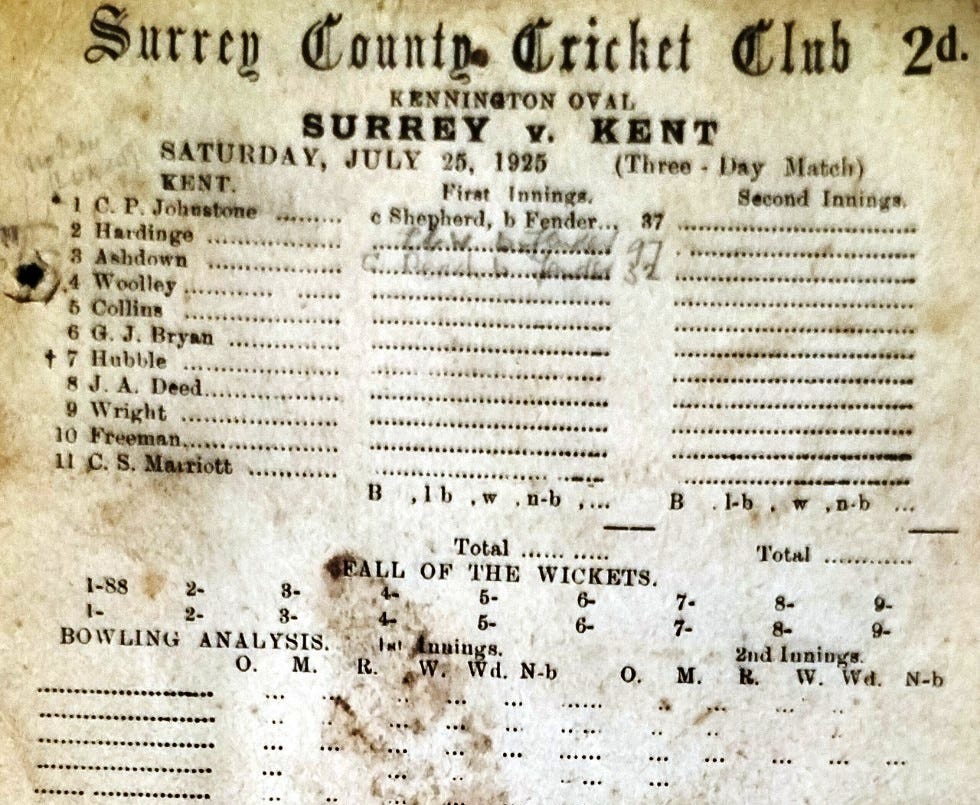
Why did Percy Fender put Kent in to bat on winning the toss at the Oval? The pitch was soft and the sun was shining, so presumably he expected the pitch to become difficult. Kent are much better equipped to bowl on sticky pitches than Surrey, so perhaps it was a policy of caution. However, the pitch remained good for batting throughout the day, and Surrey had a long day in the field, much to the disappointment of the huge crowd of about 25,000, many of whom had come hoping to see Hobbs score his vital century. He never got to bat at all today on the good pitch.
Kent went on to enjoy a fine day with the bat, starting with an enterprising opening partnership of 88 between Wally Hardinge and Con Johnstone. Hardinge especially played with great confidence and looked set for a century, but was apparently unlucky to be given out lbw when the ball apparently hit his bat handle first before his leg. Frank Woolley played a fine innings of 74 in 80 minutes and dominated a good partnership with George Collins, just returned from injury but obviously still struggling, and some members of the crowd barracked him unpleasantly. Jack Hubble became the third batsman to reach his fifty, and Kent finished the day in a strong position. The Surrey bowling had never looked very difficult and some chances were missed in the field, although some very good ones were held.
Birmingham: Warwickshire v Lancashire
Like Percy Fender, Jack Sharp put his opponents in to bat on winning the toss, only to regret it. There was a heavy thunderstorm last night, and although the pitch was covered, one end leaked badly and was quite soft, just what Cecil Parkin used to like, so Sharp took the gamble, only to find that the pitch played easily throughout and Parkin this season is not the bowler he used to be. Tiger Smith and Jack Parsons made a good start of 52 together for Warwickshire, and when Parsons was out at 84 Freddie Calthorpe came in to join Willie Quaife.
Calthorpe got his eye in immediately and launched a brilliant assault on a bowling attack that contained three Test-match bowlers in Parkin, Ted McDonald and Dick Tyldesley — although the last-named bowled well enough to escape severe punishment. He took an hour over his first fifty, but took only another half-hour to reach his century, playing brilliant strokes with his off-drives being especially notable. McDonald took the worst punishment of all, his 16 overs of the day costing 97 runs. Calthorpe scored 174 out of his partnership of 220 for the fourth wicket with Quaife, and altogether hit 29 fours, all faultless strokes. So often his drives tend to be airy and at times misplaced, but today his driving was almost perfection.
Quaife on the other hand batted for four hours for his 88, but he played a valuable supporting rôle for Calthorpe, his only fault being his refusal to be more enterprising when Calthorpe was out. In the last 25 minutes Edward Hewetson of Oxford University, playing his first match for Warwickshire this season, drove powerfully to score 32 not out.
Leeds: Yorkshire v Middlesex (Roy Kilner’s Benefit)
There was a good fast pitch at Headingley today and Yorkshire took full advantage of it. At the start of the match Percy Holmes was not present owing to his train arriving over an hour late, and Maurice Leyland was given the job of opening the batting with Herbert Sutcliffe in his place. It actually worked out well for Yorkshire, as Nigel Haig, who opened the bowling, is less effective against left-handers with the new ball, so early on Leyland took most of his bowling, while Sutcliffe faced up to Gubby Allen, who could not find his direction at all. Jack Durston eventually replaced him and bowled much better, but the batsmen were then well set and put on 218 together for the first wicket.
There was a record crowd for Roy Kilner’s benefit match, about 32,000, a little more than had attended George Hirst’s benefit match in 1904. This caused some problems, as they encroached on the playing area and also the players lost sight of the ball at times against the background of the crowd. Both Leyland and Edgar Oldroyd, who made only 1, seemed to lose sight of the ball when they were out, while Sutcliffe on 87 had an escape when he skyed a hit that may have been caught by Greville Stevens, only the latter lost sight of it instead of running forward to attempt the catch. Only one actual chance that went to hand was missed during the day, Leyland (also on 87) being dropped in the covers by Allen.
Holmes came in at No 4 and recorded another century partnership (135) with Sutcliffe, only this was for the third wicket this time rather than the first. Sutcliffe just reached his double-century before the close after batting for about 5½ hours. He was not too impressive before lunch, but in the final two sessions was superb. The weather was very hot during the day and several refreshment breaks were taken on the field. The Middlesex bowlers stuck gamely to their difficult task throughout the day, but the fielding flagged a little at times, although Ben Sherwell was almost faultless behind the stumps.
Day 2
Ilkeston: Derbyshire v Nottinghamshire
There was heavy overnight rain, and more in the morning, but the ground dried well and a start could be made at 2.30. Jim Horsley and Arthur Morton bowled to the overnight pair of Willis Walker and Bill Flint. Three overs were bowled. Five runs were scored, all by Walker. The rain returned. End of story for the day.
Swansea: Glamorgan v Northamptonshire
So much rain had fallen on Sunday and this morning at Swansea that with most grounds play would be impossible. However the St Helen’s ground dries remarkably quickly, and play could actually start at 4.30 for 2¼ hours. Northamptonshire continued their innings, and Wilfrid Timms continued his innings to make his second fifty of the match. He looked rather more comfortable than he had done in the first innings, but still batted very doggedly to score 62 in more than two hours. Only Richard Wright could stay in with him for long against the bowling of Helm Spencer, who worked up a good pace and bowled really well to taking four of the six wickets that fell today, including that of Timms. There could be a good finish tomorrow, but the odds will be on Northamptonshire, weather permitting, as Glamorgan’s shaky batting must be taken into account when chasing targets.
Gloucester Week: Gloucestershire v Essex
Continuous rain during the morning made the ground waterlogged after lunch, and it was obvious that play had to be abandoned for the day.
Bournemouth Week: Hampshire v Worcestershire
Rain caused two interruptions in play before lunch, and then a downpour during the interval prevented any more play until the final half-hour — a total of an hour and 40 minutes’ play only. The play was dominated by the superb batting of Phil Mead, who reached a fine century in 2½ hours, excellent time for him, and handled magnificently the bowling of Fred Root, who was too good for most of his partners — this on a pitch now damaged by rain. He quite dominated his third-wicket partnership of 115 with Jack Newman, who played a dogged supporting rôle for 42 in 2¼ hours before being bowled by Root for 42. The future course of this match, it appears, depends on Mead and the weather tomorrow.
Bath Week: Somerset v Sussex
There was heavy ruin during the night and this morning, so that by lunch the pitch was saturated and play had to be called off for the day.
The Oval: Surrey v Kent
Rain fell for most of the morning, and just when play was looking hopeful for the afternoon, another steady downpour from about three o’clock onwards made sure no play was possible.
Birmingham: Warwickshire v Lancashire
The weather broke yesterday evening with a thunderstorm and a continued downpour for most of the night and morning. But the ground dried quickly, the sun shone strongly and play was scheduled to start at 4.30. However, at 4.25 Jupiter Pluvius’s reserve troops swept in and took no prisoners.
Leeds: Yorkshire v Middlesex (Roy Kilner’s Benefit)
Yorkshire continued to bat this morning and pushed their score along quickly, their aim obviously being to score enough runs to ensure that Middlesex followed on. There was rain over the weekend, but it had not affected the pitch. Wilfred Rhodes was soon out this morning, but then Herbert Sutcliffe and the beneficiary, Roy Kilner, pushed the score along quickly before Sutcliffe was finally out for 235, a superb innings lasting almost 6½ hours and containing 30 fours. He was out forcing runs for the declaration. Kilner fell for 15 to a fine run-out, and there followed an enterprising partnership of 79 in 40 minutes between Emmott Robinson and George Macaulay before Major Arthur Lupton declared at 528 for six wickets. This was despite some good Middlesex bowling, especially from Nigel Haig and Jack Durston, while Gubby Allen bowled much better today.
Middlesex had to bat for half an hour before lunch, and opened with Greville Stevens and Horace Dales, the latter returning to the side in place of Harry Lee, who was for once relegated to twelfth man. The batsmen survived until lunch, but it was two hours before the players returned due to rain. When play was resumed George Macaulay bowled superbly and made inroads into the Middlesex batting by taking the first three wickets to fall. He bowled out Stevens’ off stump with a superb delivery and had Jack Hearne brilliantly caught low down at slip by Percy Holmes for 8. Dales played him better than anybody before being caught and bowled for 41. Patsy Hendren played a grim defensive innings for 24 before Holmes took another brilliant slip catch, this time off Abe Waddington. As he walked off the field rain began to fall again and ended play for the day. Yorkshire have 16 wickets to take tomorrow — weather permitting — if they are to win this match.
Day 3
Ilkeston: Derbyshire v Nottinghamshire
Play started on time at Ilkeston this morning, and Arthur Carr declared with his good overnight score and put Derbyshire in. The pitch was soft and generally easy-paced for batting, although Fred Barratt sometimes made the ball lift unexpectedly. Play lasted for about an hour — before Jupiter Pluvius returned and put an end to the match with no chance of even a first-innings decision.
Swansea: Glamorgan v Northamptonshire
More than ever, bowlers dominated the match at Swansea while few batsmen showed much stomach for a fight on a rather difficult pitch. Northamptonshire added another 22 runs to their overnight score, 21 of them to Ben Bellamy and Jack Timms in partnership before Helm Spencer tore down the last three wickets for only one additional run. Glamorgan were therefore set 171 runs to win, which would normally be a tricky target for their batsmen even in good batting conditions.
Cyril Walters and a debutant opener, Arthur Thomas, opened the Glamorgan innings quite well with 19 for the first wicket, helped by the fact that Vallance Jupp did not open the bowling, but that was as good as it got. Jupp took a hat-trick in Glamorgan’s innings; this time he took the first three wickets to fall in four balls. The Glamorgan batsmen found him almost unplayable, as he bowled a fine length with sharp off-spin to a leg-trap, but the problem was as much mental as technical. Six wickets were down for 32, all to Jupp, before there came the only fight remaining in the team, as Dai Davies and Johnnie Clay managed to take the score to 59. Then Nobby Clark removed them both, destroying Jupp’s hopes of taking all ten, but the latter then dismissed the last two tail-enders to end the match. In the whole match he had the remarkable figures of 15 wickets for 52 runs.
Gloucester Week: Gloucestershire v Essex
Charlie Parker today confirmed his reputation as perhaps the best bowler in the world on a sticky pitch as he bowled Essex to an innings defeat after play had been impossible yesterday. Conditions were merely very damp, dull and cold, when a late start was made. Gloucestershire began the day by continuing their innings from Saturday, with Alf Dipper prominent. Scoring was not very easy with a heavy outfield and very good fielding by Essex, as Gloucestershire needed to make runs quickly, but Dipper and Wally Hammond managed to put on 73 for the fourth wicket in 45 minutes. Dipper batted very well to score 121 in three hours and 40 minutes, and this enabled Douglas Robinson to declare just before three o’clock, Gloucestershire leading by 172 runs.
The sun had now come out and quickly turned the pitch sticky, while Parker and George Dennett licked their lips in anticipation. Dennett immediately dismissed Jimmy Cutmore without a run on the board, and then Parker ripped through the rest of the batting. He bowled virtually at medium pace, very accurate and making the ball rip off the pitch at very difficult angles. The top scorer was Jack O’Connor, who knew attack was the only answer and hit a six and three fours off Dennett before Parker bowled him. Essex were doomed, the innings actually did well to last an hour and a half, and Parker took eight wickets in the innings for only 12 runs off 17 overs. Four were brilliantly caught by Hammond very close in at backward point, including Jack Russell, who completed a pair, as did Claude Ashton. Only 13 other bowlers have ever taken 17 wickets in a first-class match before, and of these only three have done so more cheaply than Parker, who conceded only 56 runs in the match. Colin Blythe’s 17 for 48 in a single day for Kent against Northamptonshire at Northampton in 1907 still tops the list.
Bournemouth Week: Hampshire v Worcestershire
This was a fine day’s cricket, which ended in Worcestershire just escaping an innings defeat thanks to a fine innings from their captain, Maurice Foster. Dominating all, though, was the magnificent double-century of Phil Mead, who played one of the most attacking innings of his career and gave the bowling of Fred Root quite a hammering. He lost two partners quite early, and with the score at 217 for seven Hampshire were in some trouble — except for his presence at the crease. Then he found a good partner in Charles Brutton — although the latter was dropped three times — and in less than an hour and a half the pair were so dominant that they added 178 for the eighth wicket. To add to Worcestershire’s discomfort the last man Stuart Boyes not only saw Mead through to his double-century but hit up an aggressive 33 himself, giving Hampshire a lead of 170. Mead’s chanceless 213 not out came in about 4¾ hours, his ninth double-century, and contained 29 fours; Root took eight wickets, but conceded 165 runs off 44.4 overs, quite remarkable figures.
Worcestershire had to score 171 to avoid an innings defeat with about three hours left for play. Hampshire were without Alec Kennedy, who had been ‘called away’, but George Brown had two wickets down for 26, which brought in Foster. Given the situation, he played a more restrained game than usual. He had help from Herbert Hopkins and William Hampton, but nobody else reached 20. He scored 95 in about 2¼ hours, but no sooner had he saved the innings defeat than he got out. This opened the door again for a possible Hampshire victory, but they could not quite complete the job, and gave up the attempt in the extra half-hour with Worcestershire’s last pair together and 27 runs ahead.
Bath Week: Somerset v Sussex
After yesterday was lost to rain, this match ended in a rather boring draw. The best entertainment came from Jack MacBryan, who continued to bat confidently this morning and looked to be on course for a century when he was very well caught in the slips by George Cox off Maurice Tate for 80 with the total 103 now for five wickets. No other batsman in the team could reach 20 against the fine bowling of Tate, well backed up by Cox, and Somerset finished 90 runs behind on the first innings, with MacBryan making more than half their runs.
The best policy for Sussex would have been to push the score along quickly to build on their lead and make a good declaration, but the first few batsmen made little effort to do so; not that it was easy, as Jack White bowled very well indeed. Only Tommy Cook tried to force the game to any real extent. When the later batsmen did try to score quickly off White, the wickets began to fall, and his spell ended with six wickets and only five runs scored off him between them. Arthur Gilligan made a rather limp declaration on his own dismissal at 107 for eight, leaving Somerset to score 197 to win in just under two hours. This was never an option for Somerset against Tate, who quickly removed Archie Young, but Jack MacBryan handled him confidently again, while Tom Francis provided just the stable partner he needed to ensure against a collapse.
The Oval: Surrey v Kent
There was a late start this morning after so much rain. Kent, with a percentage of 51.76 in the championship table, would have had some benefit from a first-innings lead in this match, but Surrey, with 81.17 per cent, would have preferred a no-result match, and that is what they played for and achieved today by dour batting. There was a good crowd hoping to see Jack Hobbs score his vital century, but he edged a ball from Charlie Wright that moved away from him to the keeper and went for 22.
Andy Ducat tried to play an aggressive game, but could not time the ball well on the lifeless pitch and the heavy outfield. He had a fine battle with Tich Freeman, who could not tempt him into a fatal error. Sandham took three hours to crawl to 62 at tea, but with his team looking safe he then decided to go for his century before the close and achieved it with seven minutes to spare, having batted 3¾ hours altogether. Kent missed several chances in the field, though most of them were rather difficult ones.
Birmingham: Warwickshire v Lancashire
After more rain in the night and morning play was not possible until after three o’clock. The pitch was lifeless and there never seemed to be any chance of even a decision on the first innings, which would have interested Warwickshire, who declared at their Saturday’s score, but not Lancashire. The pitch was damp and lifeless. Freddie Calthorpe bowled out Len Hopwood in the first over, but Harry Makepeace, still a master on a rain-affected pitch, dropped anchor, helped by Jack Iddon and Frank Watson in turn. Jupiter Pluvius seems to have a special hatred for Warwickshire’s matches against Lancashire at Birmingham, as since 1921 they have all been ruined by rain.
Leeds: Yorkshire v Middlesex (Roy Kilner’s Benefit)
Yorkshire made Middlesex follow on today, but rain yesterday and some stubborn Middlesex batting meant that for the third time in four matches they had to settle for first-innings points rather than outright victory. The pitch was helpful to their bowlers before lunch and they finished off the Middlesex first innings within an hour and a half. Clarence Bruce was out almost immediately and the only real resistance came in an eighth-wicket partnership of 39 between Gubby Allen and Nigel Haig before Wilfred Rhodes came on, tempted Allen to self-destruct in the deep and the innings was soon over after that, 344 runs behind.
The pitch was easing and Yorkshire had about four hours in which to bowl their opponents out for victory. That looked very possible when George Macaulay had three wickets down for 24, including Jack Hearne lbw without scoring and Patsy Hendren bowled first ball with a beautiful delivery, all before lunch. Some time was lost to rain afterwards, which further deadened the pitch. Greville Stevens, opening the innings, was still there, playing a sound defensive innings, and he was joined by Allen at 59 for four. They stuck it out together for the last hour and a half of play before Yorkshire declined the extra half-hour, Allen restraining his usual attacking instincts, and their admirable effort secured a draw. Stevens takes most credit for his fighting defence for almost three hours. The Yorkshire bowling in the afternoon was always good, but seemed to lack the extra bite that it usually has.
Roy Kilner’s benefit, despite some dodgy weather, has been a huge success, and it is thought that he could even exceed George Hirst’s record benefit that was worth £3700. The full attendance over the three days was about 70,000.
***
The rains meant that three of the matches that finished today had no result even on the first innings, and so will not count in the County Championship table. Yorkshire, for three matches in four, had to be satisfied with three points for a first-innings lead in a drawn match, but are still well ahead of anybody else. They take a rare three-day break now in preparation for the Roses match starting on Saturday at the August Bank Holiday weekend.
With rain still about, it is impossible to predict results, and sticky pitches are also strong possibilities that may change the courses of matches. There is one Big Six match, as Kent take on Nottinghamshire at Trent Bridge — and our crystal ball tells us there WILL be a result in this match, but as usual refuses to name the winner! Surrey may have a difficult match at Gloucester, as the home county has just completed two innings victories, with Charlie Parker in match-winning form in this weather.
WEATHER FORECAST: Rain is still around and likely to interfere with most matches.