
Headingley, August 1935
Yorkshire v Middlesex

As you know by now, I collect scorecards, those fragile but instructive relics of cricket’s passing hours. This week fortune placed in my hands a fresh treasure: the record of Yorkshire v Middlesex, played at Headingley from August 17 to 20, 1935. Yorkshire, striding towards the Championship crown, had just dispatched Derbyshire at Scarborough, and now returned to their citadel for the last home match of the season.
England, meanwhile, was engaged against South Africa at the Oval, and so the county sides were shorn of their brightest ornaments. Yorkshire lacked Leyland, Mitchell, and Bowes; Middlesex were without Robins, Webster and Smith. Sellers, the Yorkshire captain, won the toss and, with a gambler’s instinct, chose to bat upon a wicket green as spring pasture.
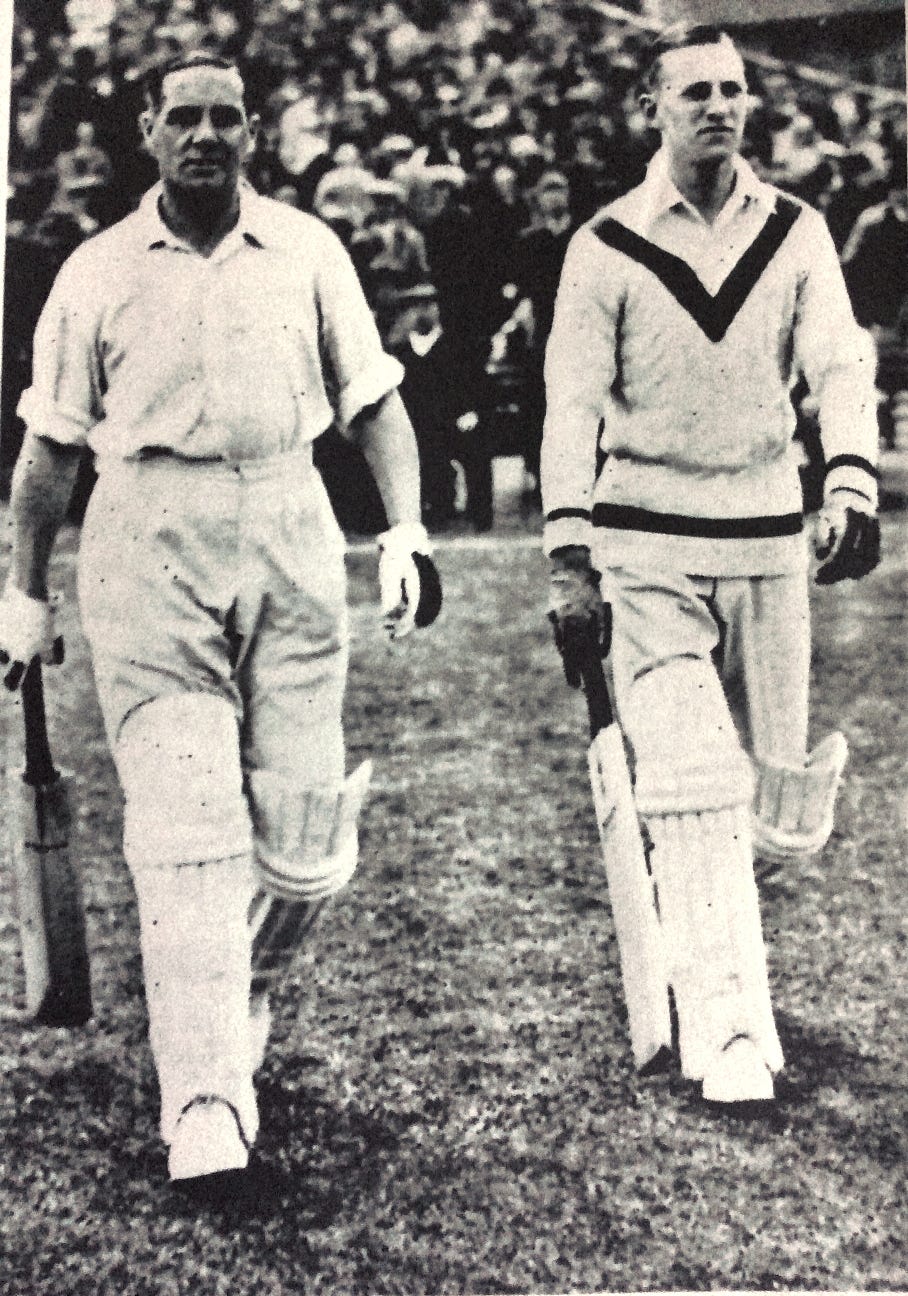
Herbert Sutcliffe, the old master, and young Len Hutton, still in the apprentice’s smock, opened the batting against Gray, a right-arm bowler whose run to the wicket promised thunderbolts but whose delivery was more candlelight than forked lightning. Young, left-arm and medium-paced, offered little menace at the other end, and so the batsmen, secure and unhurried, took their sweet time.
Just thirteen runs came in the first half-hour, and the crowd began to sigh. Then Sims replaced Gray, and Hutton lit the morning with a beautiful stroke through the covers. When Gray returned, refreshed, Hutton greeted him with another cover drive, this time with a violence that startled the still air.
Intoxicated by his success, Hutton essayed a rustic heave, sending the ball spinning over square leg—an unintended trajectory, and an ugly stroke—but the crowd, starved of drama, applauded with a disproportionate enthusiasm.
Hutton reached his half-century in an hour and a half, nudging Sims to leg. Owen Smith tried his leg-breaks, but they fell harmlessly upon the Yorkshire defence. The first wicket had reached ninety when Sutcliffe, beaten by a ball from Gray that jagged back, was adjudged leg-before. The new law permitted lbw even if the ball pitched outside off, provided it was bound for the stumps—an innovation which had claimed Sutcliffe, raised on different regulations, more than once that season. His stolid 37 in nearly two hours was typical of his autumnal years: solid, unspectacular, dignified.
Sellers joined Hutton and survived until lunch, but the interval proved fatal. Almost immediately after resumption he was bowled by Gray, playing forward without conviction. Then followed ninety minutes of cricket so somnolent that even the keenest spectator might have rebelled against the monotony. Hutton continued his stately progress, occasionally dispatching Gray or Owen Smith to the boundary. At the other end, Turner seemed a ghost at the wicket, scoring just three runs in three-quarters of an hour. His only adventure—a hit to leg—struck the umpire rather than the boundary, a comic interlude in an otherwise anonymous vigil.
Then came Hutton’s flowering. First he swung Young to leg for four, and then Sims, losing his length, was punished with two imperious drives past cover. Hutton’s hundred, compiled in three and a half hours, was a monument of patience and artistry, sixteen fours chiselled into its stone. It was greeted by a storm of cheering.
Turner, suddenly emboldened, astonished the crowd by advancing to Hearne; it was further astonished when Hulme, usually the safest of outfielders, dropped a catch before the stand. Yet Turner’s fortune was brief: At 192 he fell lbw to Sims, his eighteen compiled in ninety minutes.
Paul Gibb enlivened the period before tea with two splendid leg-side boundaries off Sims. At tea Yorkshire were 223 for three, Hutton still majestic on 124.
After the break Hulme took the new ball, and swung it with venom. Hutton, playing too soon at a good-length delivery, skied it over the bowler’s head, and Hart accepted the catch. Thus ended an innings of 131, wrought in four and three-quarter hours, his second century in a career already marked by hints of greatness.
The weather turned sullen, and a torrential downpour curtailed play with Yorkshire 272 for six. On Monday they reached 367 all out, and the wicket, dampened by rain, became a stage for Hedley Verity’s artistry. With fingers of velvet and a mind of steel, he took eleven for 73 runs, dismantling Middlesex with clinical grace. Yorkshire triumphed by an innings and 82 runs, a victory that sealed their march towards the Championship.
 | A guest post by
|