
Forgotten Pioneers
ACS Book of the Week

Note to reader: There are hundreds of fascinating free-to-read documents and ebooks on our website. Recent additions include an exhaustive history of the first three installments of the ICC Trophy (forerunner of the Cricket World Cup Qualifiers), and the ACS’s foundational collection of statistical surveys (1863-1881), along with Derek Noakes’s invaluable index to the player biographies and obituaries in same. All this—and much, much more—is available in our Online Library.
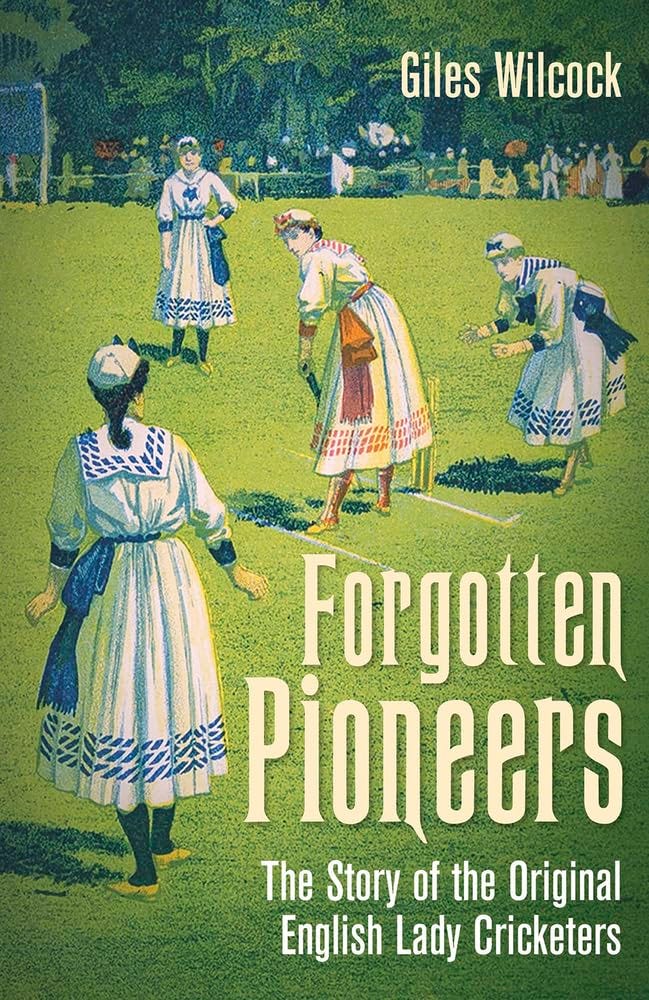
Each week we spotlight a fascinating title from the vast collection catalogued in the Cricket Bibliography project, drawing on insightful (but not necessarily positive!) reviews from the archives of our journal. Today we bring you Forgotten Pioneers: The Story of the Original English Lady Cricketers (2024) by by Giles Wilcock, reviewed by Richard Lawrence.
Some forty-five years after the launch of the All-England Eleven which did so much to popularise cricket in England, a not-dissimilar troupe, billed as the Original English Lady Cricketers (OELC), toured the length and breadth of the British Isles playing exhibition matches among themselves. The matches drew good crowds, often in excess of a thousand, and also attracted considerable media attention – although not much, it has to be said, from the mainstream cricket press. Yet part-way through the second season, the venture ran into financial difficulties and collapsed ignominiously. The story of the OELC, the characters involved, and the reasons why it failed to advance women’s cricket, are the subject of this fascinating book.
The origins of the OELC and the entrepreneurs behind it are shrouded in mystery, and Giles Wilcock is obliged to exercise the deductive skills of the ladies’ fictional contemporary Sherlock Holmes to draw any conclusions; sometimes the evidence is scant, or contradictory. What is clear is that the OELC manager, one Edward Michell (or Eduard Michel), was probably not quite as he appeared, and the players in his charge were certainly not the middle-class ladies he claimed them to be. Most were working-class women, some of them from poor homes, for whom the salary of a professional cricketer represented a considerable advance in living standards, even though somewhat lower than that of a male professional of the day.
There seem to have been a number of weaknesses in the OELC business model. The overwhelming majority of the matches they played were between sides taken from their number: the so-called Blues and Reds. Motivation for the players must have been difficult, and the results a matter of indifference to the spectators. By no means all the players were proficient at the game, particularly in the first season. Add to this an attitude from the contemporary press that usually – with a few exceptions – ranged from the patronising to the downright misogynistic, and it is a wonder that the OELC were for a time highly successful. Yet these do not appear to have been the causes of the ultimate demise of the enterprise. Crowds in the second season in 1891 were good, and there are signs that practice over the winter had improved the standard of play. The origins of the failure of the OELC seem to lie in the shadiness of the management, with accusations that the takings had been purloined and payment unlawfully withheld from the players. One of the managers was taken to court by one of the players, yet even this serves only to add to the mystery, as the other players do not appear to have been involved in the lawsuit, which did not target the man to whom what evidence there is points as the likely culprit.
With source material frustratingly vague or non-existent, Wilcock is hard put to it to make sense of events, and occasionally resorts to speculation, but for the most part his conclusions seem well-founded and credible. Even if it is impossible to be certain of the truth, he tells a story that is both riveting and enlightening. The rise to prominence of women’s cricket in the last ten years or so has as yet had little impact on the world of cricket books, but of the handful of books dealing with the women’s game, this well written account of a little-known but important episode in the history of the game is the most interesting that I have read.
 | A guest post by
|