
Cricket Walkabout
The First Australian Cricketers to Tour England

We’re delighted to share with our readers an exclusive deal with Pitch Magazine for their bumper Ashes issue, which has just hit the shelves. Use the code ASHES20 at checkout to get 20% off!
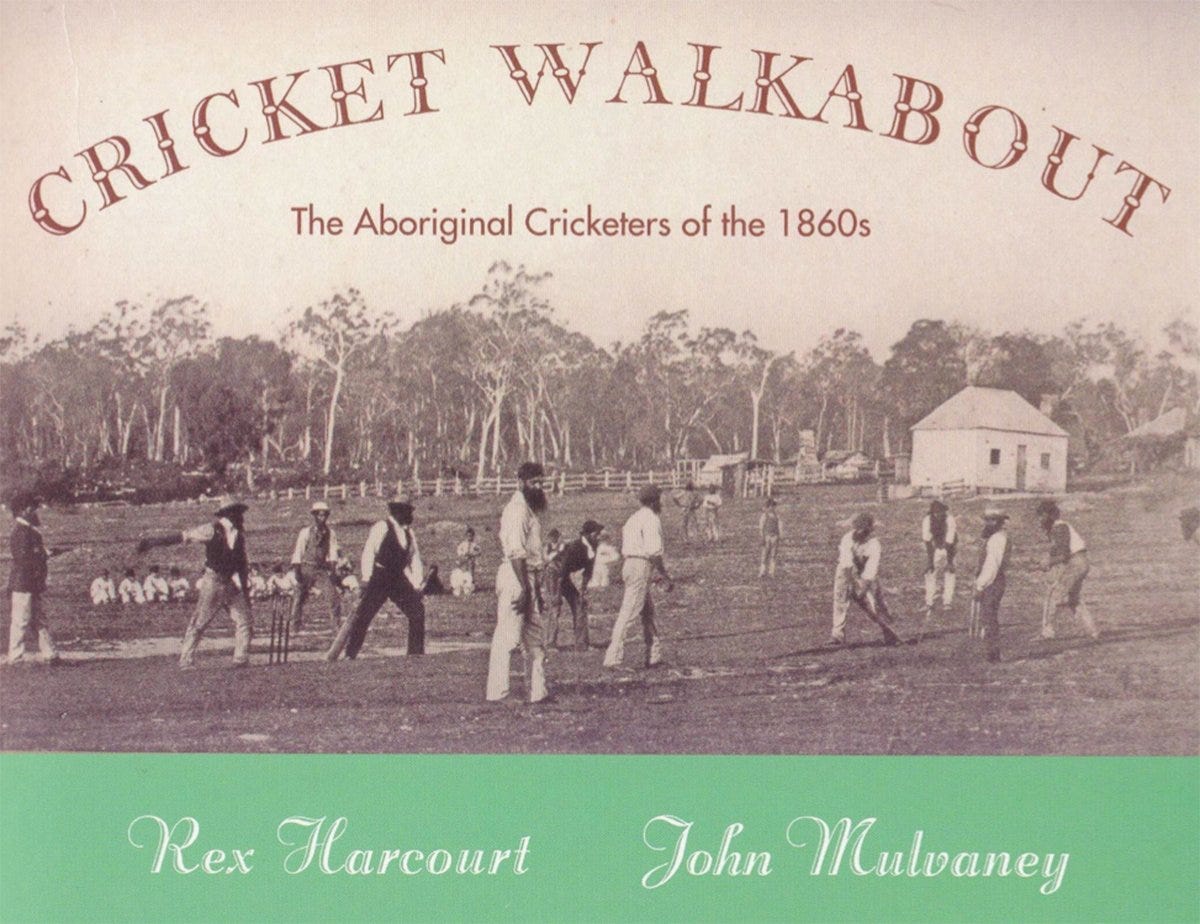
Each week we spotlight a fascinating title from the vast collection catalogued in the Cricket Bibliography project, drawing on insightful (but not necessarily positive!) reviews from the archives of our journal. Today we bring you Cricket Walkabout: The Aboriginal Cricketers of the 1860s (2016) by Rex Harcout and John Mulvaney, reviewed by Charles Barr.
‘Who were the first cricketers to visit England from overseas? D.W. Gregory’s Australian team of 1878 is commonly credited with being the earliest… Actually, this is incorrect; though the 1878 team was the first representative Australian XI to make the ocean trip. Ten years previously a cricket team from Victoria had visited England.’
This is the opening not of the book under review, but of a substantial chapter in a collection published in London as long ago as 1949: The Charm of Cricket, Past and Present, by Major C.H.B. Pridham. This happens to be the first cricket book I was ever given, by some family friend who knew of my youthful passion; read and re-read over the years, it made a lasting impact, not least the 1868 tour chapter honouring the feats of Johnny Mullagh and Dick-a-Dick and their bold Aboriginal team-mates from Victoria: good-quality cricket and, after close of play, much else, from competitive running and jumping to boomerang demonstrations. So I was keen to in see Cricket Walkabout, and to get the much fuller updated story, from the Australian angle.
This book is a deeply scholarly one, culmination of more than half a century of research. First published in 1967, it was followed by new editions, building on a range of fresh discoveries and on an expanding, if belated, Australian commitment to the study of First Nation history and culture. Essentially it tells two interlocking stories: that of the tour itself, such a bold and taxing pioneer enterprise, and that of the progress, through the decades, of research on and around it – research on the players, and their lives before and after, and on their increasingly visible legacy, typified now by the Johnny Mullagh Medal, given annually to the outstanding player in the Boxing Day Test. The book ends with a moving assembly of tributes from young to old: from descendants of some of the 1868 tourists, and from family of the two dedicated authors, Mulvaney and Harcourt, both of whom lived into their nineties, and whose own names rightly remain attached to this fresh edition of their work.
A recurring point is made about history’s long failure to recall or to honour the tour of 1868. Rowland Bowen’s history brushes past it. Richard Mulvaney recalls his father “being outraged in 1977 at the festivities around the centenary of the first Test match between Australia and England. It was as if the 1868 tour had never occurred.” But what, then, about Major Pridham and his very positive long essay of 1949, complete with some full scorecards, and all the tour averages? He is not mentioned in Cricket
Walkabout, whether because acknowledging him would complicate the master-narrative of the gradual rediscovery of a forgotten tour, or, more likely, because it simply was not known to them. A forgotten figure himself, Pridham deserves attention, but this is not the place to say more.
I have been able to read Cricket Walkabout only as a pdf file, an awkward process in its wide double-page format. The illustrations are so good – abundant, varied, handsome, always evocative – that it would double the pleasure to have them laid out on the page. If you can get the book in that form, I recommend doing so.