
Cricket Across Dark Waters
The colourful story of India-West Indies tussles

Each week we spotlight a fascinating title from the vast collection catalogued in the Cricket Bibliography project, drawing on insightful (but not necessarily positive!) reviews from the archives of our journal. Today we bring you Cricket Across Dark Waters: The Colourful Story of India-West Indies tussles (2025) by Arunabha Sengupta, reviewed for us by Charles Barr.
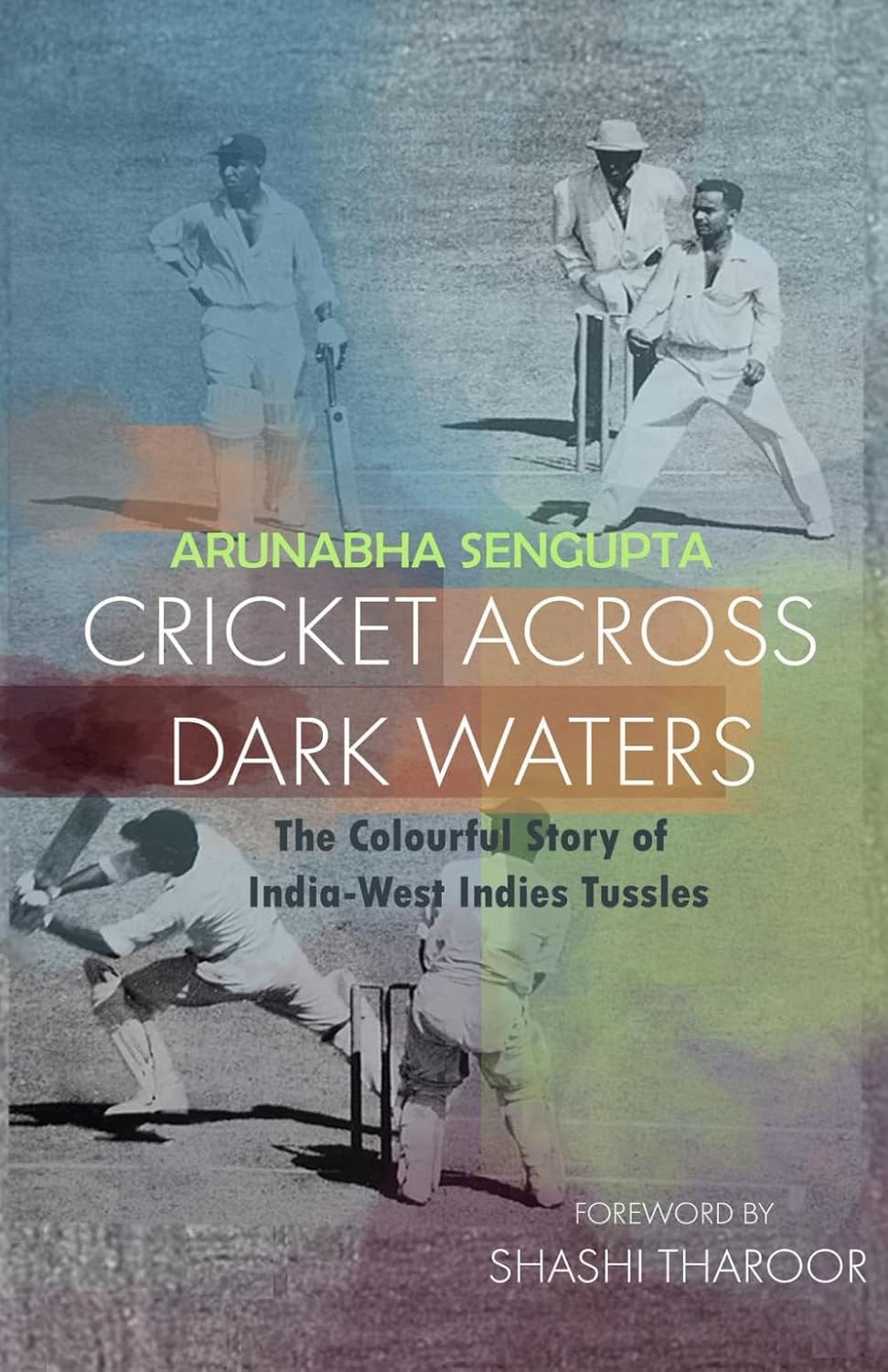
This is an important book, no question. To say it ‘fills a gap’ is too patronising. In the author’s words, it is ‘an attempt to fill [one] gaping hole in the documented history’ of the game, namely the interlinked stories of West Indian and Indian cricket, from, and indeed ahead of, their first Test series, played in India in 1948-49, two decades after both were granted Test status by the ICC. But ‘this is just one step in filling many, many such holes that riddle the largely one-dimensional history of a multidimensional sport’ – referring, of course, to an Anglo-Australian dimension that remains dominant, in authorship, subject-matter (matches, biographies) and in its broad perspective. Never forget that until 1965 ICC meant Imperial Cricket Conference, changed to International only to accommodate South Africa’s departure from the imperial family.
Cricket Across Dark Waters supplies a model for how a new historiography can be opened up. Its framework is a meticulous inventory of Test matches played between these two sides over the years, series by series, day by day within each Test. Patterns of change are traced with clarity and insight, notably (1) the steady global expansion of ODIs and T20Is, and then T20 franchises, alongside Tests, and (2) the equally steady shift in the balance of power between the two tussling teams. Teams, not nations, the West Indies being such a precarious and short-lived federation of territories, whose star players, for good economic and cultural reasons, give increasingly less weight to the international game than do their Indian counterparts.
Other scholars have done comparable analyses of this complex of changes, notably Tim Wigmore and Freddie Wilde in Cricket 2.0, Wisden’s Book of the Year in 2020, a book by two English authors for Edinburgh publication, and to that extent representing the old ‘one-dimensional’ history that Sengupta challenges. It may seem surprising that he calls the book ‘fantastic’, but it makes sense. That book is far from narrow in its perspective, nor, in turn, is his own work: both are part of a move already under way towards the multidimensional history that he advocates. Readers may be moved to look back to issue 204 of this Journal, and the eight-page report, written by Sengupta himself, on the all-day symposium in 2023 at which he was a main speaker, ‘No Foreign Field: MCC and the Empire of Cricket’. How I regret not having been able to attend this. Alongside this report can be read, or re-read, his delightful jeu d’esprit ‘Sherlock Holmes and the Birth of the Ashes’ (Max Books, 2016), set at the Oval in 1882 – could any cricketing topic be more one-dimensional? It is his deep familiarity with the old histories and the Anglo-Australian game past and present (see also many of his online essays) that helps to make the call for wider perspectives so persuasive.
Back to the book itself. Dip in at any point and you find vivid detail both of on-field action and of issues of both cricketing and wider politics. My one reservation relates to the index: messily laid out, names only, no places or themes, and no subdivisions, over 40 bare numerical entries for Gavaskar and for Richards, to name but two of the narrative’s great men. Stephen Chalke at Fairfield, on record as a fan of Sengupta, would have done a better job – of the Index. But it is apt and admirable to have the book published by an alliance from the Netherlands, now Sengupta’s home, and Trinidad and Tobago. New dimensions indeed.