
Chasing Jessop
Richard Lawrence on Simon Wilde's latest

This is the latest in a regular series in which we spotlight a fascinating title from the vast collection catalogued in the Cricket Bibliography project, drawing on insightful (but not necessarily positive!) reviews from the archives of our journal. For more like it, click here and become an ACS member.
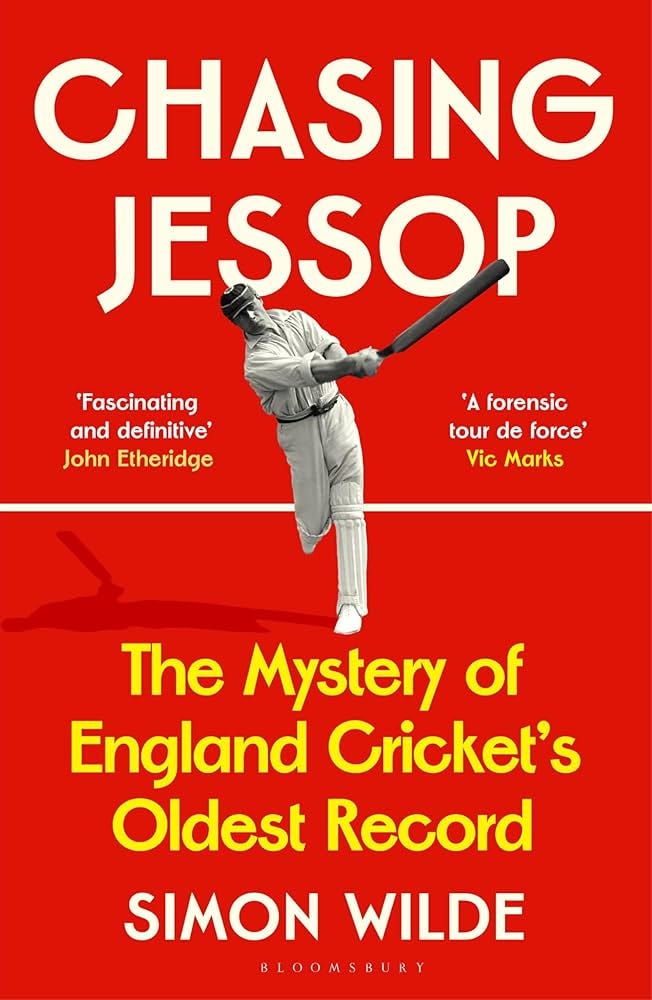
It has been my pleasure in the last few months to review a couple of outstanding books dealing with records from the Golden Age which have endured to the present day. Last time I included a review of Trumper Across the Tasman, with a chapter on what remains the world-record eighth wicket partnership. This time it is the turn of Gilbert Jessop’s record for what – at the time of writing – remains the fastest Test century by an England batsman, a record which is frequently referenced in modern Test coverage as the current crop of attacking batters come close to emulating Jessop without ever quite breaking his record. It has of course been broken several times by overseas players, including McCullum himself, but so far not by a Englishman. The author’s motivation to write the book was driven particularly by the desire for it to be complete while still topical, and hence it was written at greater speed than some of his other books – not that it shows.
We are first given the context with several chapters on the run-up to the Oval Test and Jessop’s career to date. The 1902 Ashes series had already produced some compelling cricket, notably the fourth Test at Old Trafford, from which Jessop had been controversially omitted, there being, as now, some suspicion towards batters whose style is primarily attacking. In fairness, while he had scored quickly, Jessop had not till then quite delivered on his promise, and had been a failure on his only tour of Australia.
Wilde then gives a detailed description of what is undoubtedly one of the most exciting Test matches ever played in England, with a particular focus on the last day. The scorebooks no longer exist, so the author has had to resort to careful research, forensic analysis and a little speculation to reconstruct the day’s play. That he has done so successfully is a tribute to his dedicated quarrying in a wide range of newspapers and other sources. The detailed coverage includes not only Jessop’s innings but also the progress of the match after he had been dismissed, with a reminder that whatever he may or may not have said to Rhodes, Hirst did indeed score most of the required runs for the last wicket in singles.
The author has delivered several high quality books in recent years, but in my opinion this is his best, and I returned to it with pleasure each evening while preparing for this review. Well written, nicely produced, with a selection of illustrations that illuminate the text, a detailed but not over-long statistical appendix and a good index, this should please both the historian and the statistician.