
At the Perth Test
From the ABC statistician's notebook

New from the ACS: Explore our search tool, now live at archive.acscricket.com. It offers a growing index of ACS records and digitised publications, and includes searches of the Women’s Cricket History website. These comprehensive resources are now at your fingertips.
We’re also delighted to share with our readers an exclusive deal with Pitch Magazine for their bumper Ashes issue. Use the code ASHES20 at checkout to get 20% off.
Day 1—Friday
Perth dawns bright and sunny, as it has for the other 223 days of its 55-year Test career. Still boasting its crown as the only (major) Test venue in Australia not to have lost a day to rain, today’s not going to alter that. And if you’ve read my report on the corresponding match last year, you will see what I have done there. No gain in re-inventing a wheel that’s worked in Perth for over half-a-century.
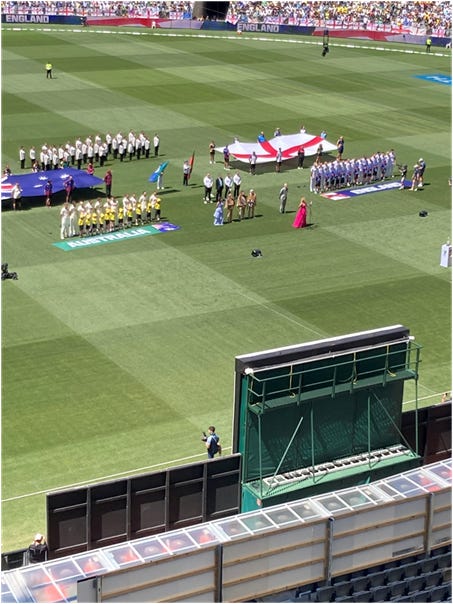
This is the sixth Test at Perth’s second Test venue, the city having previously hosted 44 Tests at the Famous WACA ground between 1970 and 2017. It’s also England’s first visit to the newer stadium, having won only one in fourteen attempts at the older ground across the river, by 166 runs against an Australian team weakened by the Great Packer Schism in 1978. They missed playing there in 2021 because Covid prevented anyone getting in, and got flogged at Hobart instead. But with India having trounced Australia here last year (Australia having won the first four at the new ground), they come with hope in their hearts.
The Australian Broadcasting Commission is represented on this auspicious occasion by Jim Maxwell, Corbin Middlemas, Alison Mitchell, Darren Lehmann, Jason Gillepsie and Tom Moody, with English expertise provided by Jonathan Agnew and Phil Tufnell.
The McCullum/Stokes Brains Trust have clearly done their homework, because on winning the toss, they elect to bat on a wicket that is a deeper hue than our national political party of the same name (this despite Stokes inserting the opposition in the five of the last six times he’s won the toss). The reason for this departure from normal policy is probably something to do with the fact that all five of the previous toss-winners here have elected to bat—and won the match. First strike to England.
Australia have two debutants in a Test match against England for the first time since 2011, when none other than Usman Khajawa and … Michael Beer (remember him? me neither!) played their first Tests. The last pair to make their debuts in a first Test of an Ashes series takes us back to 1993 (Brendan Julian and Michael Slater), and the last time in the first Test of a series in Australia reminds us once again of Kerry Packer, when the selectors were scrabbling around to find anyone who would play. On that occasion, in 1978, Rodney Hogg and John MacLean volunteered—worthy additions to Australia’s list of Test players.
The Bazball backdrop to this series is fascinating. In the three-and-half-years before the appointment of Brendon McCullum to England’s coaching position, England scored at 50.96 runs per 100 balls, imperceptibly ahead of their direct opponents (50.89), and behind all other Tests not involving England (52.33). Since his takeover of the role in May 2022, England’s run-rate has sky-rocketed to 76.11; their direct opponents have followed to a lesser extent to 58.54. There has even been a rise in those Tests not involving England: 57.00. Normally one would expect a tradeoff between increased aggression and maintaining wickets, but the transformation has been worthwhile: England’s batting average has increased over the two periods from 27.90 runs per wicket to 36.66, while their direct opponents’ has fallen from 31.85 to 29.81, perhaps intimidated by (or trying to emulate) England’s full-frontal attack.
The difference in results over the two periods mirrors the above analysis. There happens to have been 41 Tests played by England in each period. In the first, it was fourteen wins, eighteen losses; in the second, 25 wins, eleven losses.
Stokes may be fortified by the fact that Rory Burns is not playing for England this time, as he was four years ago at the Gabba when he was bowled around his legs by the first ball of the series. However, Ben has overlooked the fact that the bowler of that ball, Mitchell Starc, is playing, and like clockwork, he induces a speculative cover drive from Zac Crawley off the last ball of the first over, angled cross him. Crawley edges it to first slip. In fairness, he was a little unlucky in that Usman Khawaja did everything possible to drop it, but somehow hung on, and so England, once again, are 1/0.
Starc is has made a habit of early disruption to opposition batting, and the stats bear it out. He has claimed the first wicket of a Test innings with the team total on zero on no fewer sixteen occasions, well ahead of Glenn McGrath (13), Dale Steyn and Chaminda Vaas (12 each), Curtley Ambrose, Ray Lindwall, and Zaheer Khan (11 each) and Jimmy Anderson, Richard Hadlee, Shaun Pollock and Courtney Walsh (10 each). And if you extend the search any wicket taken with the opposition yet to score, then Starc goes to 18, ahead of Lindwall (14) and McGrath (13). Changing the search to a batter facing first and scoring a duck, regardless of the team score, sees Starc (still 18) relegated to second position behind McGrath (20), but ahead of Ambrose (16). Sherwin Campbell (WI) once fell to McGrath for 0 when the score was 1/11!
And, speaking of ducks, opening batters all round the world have good reason to be fearful when selected for a Perth Stadium Test. Openers falling for a score less than one in the five Tests there before today are Murali Vijay, KL Rahul (2018), Tom Latham (2019), David Warner (2023), and Yashasvi Jaiswal and Nathan McSweeney (2024). Only one Test here hasn’t been blighted by an opener’s duck: Australia v West Indies in 2022.
Once Crawley fell for a duck, Joe Root’s fate was sealed. It is a well-known fact that when an English opener falls in the first over to Mitchell Starc in the opening Test of an Ashes series, Joe Root later also falls for a duck. I’m guessing it’s a solidarity thing. It happened in 2021, and of course, it happens again today. My fellow commentators are amazed at my predictive qualities, but really, it’s nothing to do with me. It was just meant to happen.
Mitchell Starc, not content with breaking down England’s door in the first over, continues his rampage throughout their whole residence (consisting of just 32.5 overs) to end with 7/58 as the visitors are sent packing for 172. This is the first time Starc has claimed seven wickets in a Test innings, and indeed he improves his Test-best analysis just one innings after having done so previously, when he inflicted the improbable figures of 6/9 on the hapless Windies back in mid-July. In doing so today, he moves past the fearsome Ambrose (now in eighteenth position overall, on 405 wickets) to land on 409, and makes significant progress towards overtaking another formidable left-arm quick in Wasim Akram (414). He has also today become the fourteenth Australian to take 100 wickets against England.
Starc’s bowling dispels fears about the missing Josh Hazlewood and Pat Cummins, but one consequence of the absence of these two is that the world-leading quartet of Cummins, Hazlewood, Lyon and Starc cannot move beyond its current peak of 567 wickets when all four play together, 152 ahead of the next best (England’s Moeen, Anderson, Broad and Stokes, with 415).
The end of the England innings allows me to complete the following table detailing the fortunes of those involved in the first balls of Ashes series since World War II:
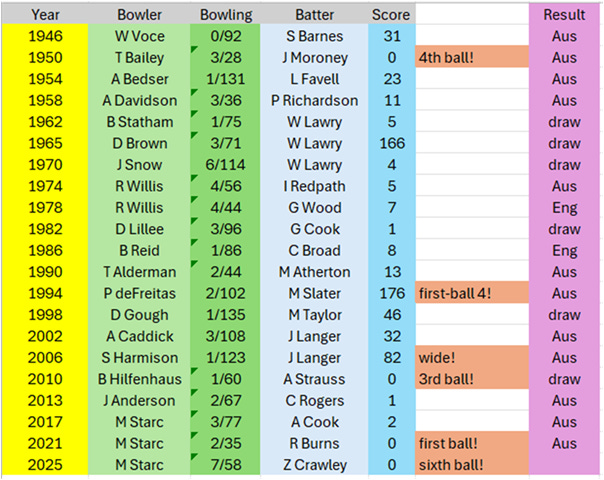
You can see that it generally doesn’t end well for either combatant of that first ball, apart from lone performances from John Snow, Bill Lawry and Michael Slater. Before today, the bowling average of the bowlers involved was 34.34, while the batting one was just 29.19 (only 14.26 without the two century makers). And, speaking to an earlier point, not only should opening batters be fearful of coming to Perth now; they should also try their level best not to be selected for the First Test of Ashes series, with the last five candidates having a combined average of 0.6 since the glory days of Slater, Taylor and Langer. And not only does Mitchell Starc snatch today the best figures by a bowler bowling first in an Ashes series since 1945; it can be seen that he is now the first bowler to deliver that first ball in three different series. The only player on the batting side to achieve similar status was the generally immovable Bill Lawry, who defied his reputation twice by succumbing cheaply, but confirmed his reputation on the middle occasion.
Australia’s reply is thrown into instant disarray when it is revealed that Usman Khawaja, who has spent a lot of unexplained time off the field, is not permitted to open because of said absence. Turns out he has suffered back spasms, and furthermore has spent a significant part of the week leading up to the Test playing golf. There are a few furrowed brows in the Australian camp, lead by skipper Steve Smith, and well-emulated by our expert panel of Tom Moody, Jason Gillespie and Darren Lehmann who don’t hold back. It’s not a good look.
Jake Weatherald, Australia’s 472nd Test player, is given out lbw while lying flat on his face on the pitch for 0—the 433rd Test player to do so (not all, admittedly, lying flat on their face), and the 56th Australian. Marnus Labuschagne (who is forced into opening) and Travis Head sympathise with Jake, because they’ve done that too, while Gus Atkinson, another debutant duck, smirks from fine leg. Those who have fallen off their second ball are a more select group, there being only 47 of them (looking at you, Marnus), while Michael Atherton (0[2], Trent Bridge, 1989) shifts uncomfortably in his TV studio.
It’s always interesting, when considering player numbers, to compare Australia’s progress with England’s. Player #472 for England is Roger Tolchard—New Year’s Day, 1977, nigh on fifty years ago. Brendan Doggett, #473, is paired with Derek Randall, who debuted in the same Test as Tolchard.
The less said about Australia’s miserable batting response the better. The most remarkable thing that happens is the mind-boggling feat of Ben Stokes, England’s captain, who thought the wicket was good enough to bat on when he won the toss, but ends up snatching a personal “five-fer” on the first day. A quick search of the trusty database confirms he is the first skipper-bowler to do that in Test history. And he is only the sixth England captain to claim five wickets in an Australian innings, after FS Jackson, JWHT Douglas, GOB Allen, FR Brown and RGD Willis.
Australia reach stumps at 9/123, thus ending a 19-wicket day, the first time in Australia since 1951-52, when it happened twice—at Adelaide (22 wickets), and Sydney, against the Windies. It had previously happened in this country in 1931-32, 1901-02 and 1894-95. So, this sedate day’s cricket has seen 295 runs scored off 71.5 overs at 4.23 runs per over, with wickets falling every 22 balls, and costing 15.52 runs each. And I genuinely thought I was working at a Test match.
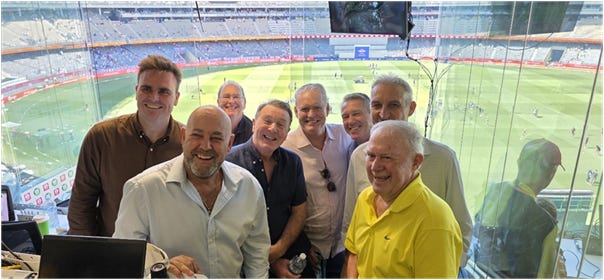
ABC – Perth, 2025-26 - from left:Corbin Middlemas, Darren Lehmann, Ric Finlay, Phil Tufnell, Tom Moody, (imposter) Glenn McGrath, Jason Gillespie, Jim Maxwell.
Day 2—Saturday
Australia’s tailenders hang on for 38 balls this morning, and advance the total by another nine runs. Round One to England: forty runs to the good at the half-way stage.
Zac Crawley, who obviously thinks his first-innings duck has yet to convince us it occurred, goes out and promptly scores another, spooning a half-drive back to the irresistible Starc, who takes a spectacular left-hand catch sprawled over Perth’s primest bit of real estate, off the fifth ball of the innings. Crawley, who after 12 Test innings boasted an average of 48.42, has now declined to 30.96. He joins fellow English openers Atherton (twice), Holmes, Bailey, Pullar, Luckhurst, Amiss and Larkins in suffering the indignity of a pair. He joins Australia’s AC Bannerman (Lord’s 1888) as the only pair—geddit?—to score a pair as an opener in the first Test of an Ashes series. I’m not sure Bannerman is around to welcome him to the club. The last to do it in any Test is Zimbabwe’s Brian Bennett, against New Zealand back in August, while Pakistan’s Abdullah Shafiq (Sydney, 2023-24) is the last to do it against Australia.
We now have the first Test ever in which the first three innings have each started with a wicket before a run is scored. There are two Tests, however—and both featured Australia—in which the first, third and fourth innings have started the same way: v. England at the Gabba in 1950, and v. Pakistan at the SCG in 2024.
At 1-65 (Duckett 28, Pope 30), England are 105 ahead with nine wickets in hand, and odds-on to take a one-nil lead in this Ashes series. The WinViz predictor app is off the scale. I move to consult the database to see when Australia last lost the first Test of a home Ashes series (39 years ago, for those interested).
At this point, England self-destruct, losing upper- and middle-order wickets at 65, 76, 76, 76, 88 and 104, before a mini-recovery takes them to 164—a lead of 204. Only once in the third match innings of Tests against Australia have England lost their third wicket at 76 (coincidentally at Perth in 2013-14), so it can happen—but to lose three wickets at that total is just plain careless. Jason Gillepsie makes the point that he faced more balls in his nightwatchman double-century in 2006 than the entire England team batting twice.
The main architect of England’s quick demise is Scott Boland, who looked off the pace in the first innings, being too full and being struck many times down the ground to the short straight boundaries. Today, he pulls his length back a bit and takes his first wicket at 65, and two more at 76. He finishes with 4/33, bringing his career bowling average back to 16.97, still well above the 7.86 it was after his famous 6/7 at the MCG in 2021, but nevertheless trending down after peaking at 20.70 after some rough treatment from England in 2023 and India last year. There only three bowlers with his 66 Test wickets or more who have a lower bowling average: George Lohmann (10.76), SF Barnes (16.43) and CTB Turner (16.53), all of whom played well over a century ago.
Australia are set 205 to win, not a fait accompli given all that has gone on before, and a score that would be the largest of the match. If achieved, this would be only the eighth time in Tests in Australia when this happened, and the first since Pakistan made 450 at the Gabba in 2016 to fall tantalizingly short of victory.
Travis Head becomes the third Australian to open in this match, with Khawaja still struggling; he earlier in the day leapt high in a forlorn attempt to take a catch at first slip, crashed back to earth and limped off minutes later, complaining he couldn’t stand up. It will be the last we see of him in the Test.
Head starts sedately, with no inkling of what is to come. He hits his first boundary off his fifteenth ball, having scored just 3 runs off the previous fourteen, and gets to double figures two balls later.
He then steps up the momentum, taking a six off the first ball he faces from Brydon Carse, and repeats the dose in his next over. He reaches fifty off 36 balls, takes seventeen off a Ben Stokes over, and achieves his ton after a further 33 balls. He clubs eighteen runs off his final six, before retreating triumphantly to the change rooms with 123 runs off a mere 83 balls. He has turned this match on its “head”—see what I did there?—and when he leaves, Australia are only a dozen runs behind England.
A short time later, Labuschagne and Smith comfortably take Australia to a most unexpected victory, given the situation four hours earlier. Head has hit sixteen singles, five twos, three threes, sixteen fours and four sixes. On the face of it, the 39 dot balls seem totally unnecessary. His average return from each scoring shot in the second innings was 2.73 runs; the average return from every other scoring shot in the match was 2.23 runs. In this innings, Head faced 11.1 per cent of the balls bowled in the Test, and scored 18.2 per cent of the runs, personally striking 23.5 per cent of the fours, and fifty per cent of the sixes.
Head has now played three outstanding Test innings against the general run of play: 92(96) against South Africa at the Gabba in 2022, 119(134) at Adelaide against the Windies the following season, and now 123(83) at Perth.
All over in 847 balls, this Test is the second-shortest of all played in Australia, after the abject South African effort at the MCG in 1931-32 (656 balls).
The run-rate throughout the Test, 4.77 runs per over, is the highest in the 362 Tests between Australia and England—next highest is 4.36 at Edgbaston, 2001—and the fifth-highest in all 2608 Tests. (The highest was 4.96 by England v. Zimbabwe, Trent Bridge, 2025.) Wickets fell at the rate of one every 26.47 balls, the fourth-lowest in Australia-England Tests, and the lowest since 1896.
With the Test wrapping up just ten minutes before the scheduled end of play, the chronology of Tests between the two countries that have been completed in two consecutive days now runs 1882, 1888, 1888, 1888, 1890, 2025. In addition, there are two Tests, 1895 and 1921, where the only two days of play were separated by a day of no play.
Day 3—Sunday
We seem to have only just arrived in Perth, got our breath back, and now we are forced to think about leaving this fair city. To delay our premature departure, we therefore decide to conduct Day 3 at Fremantle, a raucous 30-minute maxi-taxi ride from our digs in central Perth. Boof Lehmann, our social captain, has booked us a very big table at a very large and loud warehouse-cum-bar, and we spend the six hours playing time for the day, replaying the first two days with increasing animation as the afternoon wears on. It seems everyone intending to see Day 3 at Perth Stadium has the same plan, and it’s fair to say a good time was had by all. The choral work of the group in the taxi on the return journey after stumps had to be heard to be believed.

Gage Roads Brewery, First Test, Day 3 -ABC broadcast crew + hangers-on– 3657 Test runs, 837 wickets, 7 Barbershop Harmony Australia medals.😊
 | A guest post by
|