
At the Melbourne Test
From the notebook of the ABC's statistician

As is customary now, I travel to Melbourne on Christmas night. It gives me some quality Christmas family time, while at the same time avoiding the frantic scrambling associated with flying in on Boxing Day morning. I tried that once—never again!
Thursday, 26 December
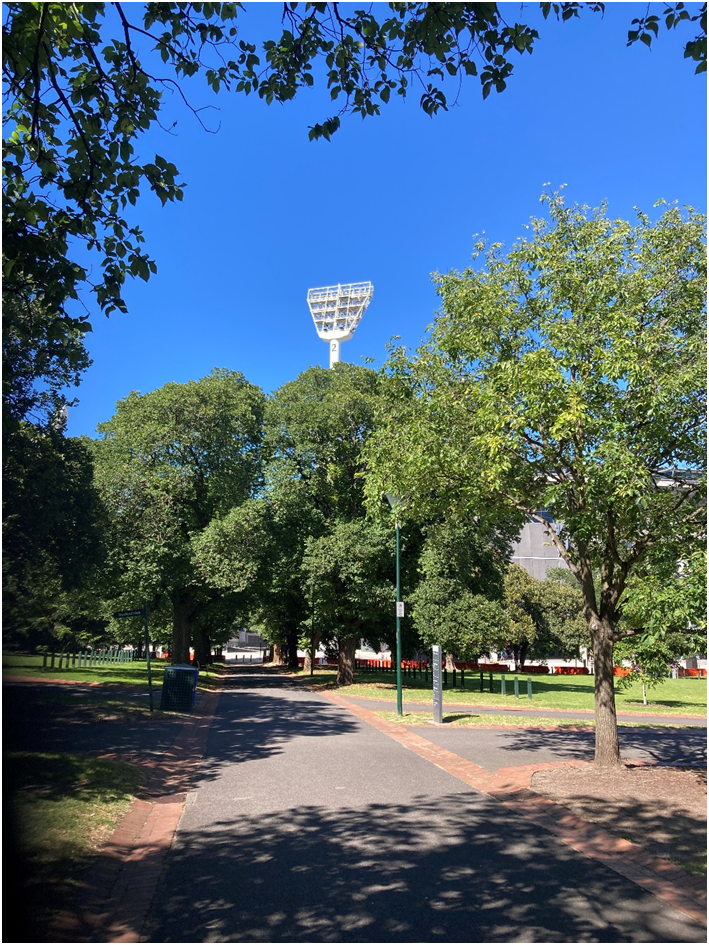
Pat Cummins and Nathan Lyon, having provided quality guest performances at Adelaide, are declared unfit to take any further part in the series, and thus Mitchell Starc soldiers on, alone, bereft of the trio (the above plus Josh Hazlewood) which made him part of what was, until this summer, the best bowling quartet in Test history. Michael Neser is recalled after his Brisbane triumph, while Jhye Richardson leapfrogs Brendan Doggett to take Lyon’s place. This means there is no specialist spinner, and my first glance at the pitch when I arrive at the ground reveals why. The Dublin Bowling Club would be proud of this horticulture.
For England, Gus Atkinson returns in place of the stricken Archer, also a permanent casualty as far as this series goes, while the selectors’ patience with Ollie Pope is not boosted by any Christmas cheer; he makes way for Jacob Bethell, already with four Tests to his name, but only 22 other first-class matches, and a top score of 96, made in his second Test.
Ben Stokes wins the toss and has no hesitation in electing to bowl. He is clearly persuaded by the strip of vegetation in front of him, for the ground stats suggest the opposite course: On the 82 occasions a captain has elected to bat, he has won 41 and lost 30, whereas sending the opposition in (35 times) has resulted in 12 wins and 17 losses.
The MCG is one of England’s more successful venues, winning 20 and losing 29 out of 57 previous visits. Australia has won 68 of the 118 Tests played here, and lost as many as 32, demonstrating that this surface doesn’t facilitate the same home-team dominance as some other grounds around the country.
Head and Weatherald start cautiously but for the most part safely, and then Carse, opening the bowling opposite Atkinson, goes for 15 off his third over. Normal service appears to have resumed.
The very next ball, from Atkinson, cleans up Head, however, and we enter a period of Australian despondency: Tongue relieves the expensive Carse, and takes a wicket in each of his first two overs. One of these is Marnus, edging to Root at slip for 6. I am moved to comment that in his last 22 Test innings, Marnus has five scores above 50, but as many as 16 below 22, which is not the distribution he wants after his recall to the team this summer.
Wickets continue to tumble, and lunch is taken at 4-72. When Carey, Australia’s rod of steel in the middle order this series, departs at 6-91, I observe that this was always going to happen, because the last innings Australia played here, in the second innings against India twelve months ago, he was also dismissed with the score at … 6-91. These little gems are sent from above to entertain us, I am sure.
Michael Neser offers stout resistance, and equals his previous-highest score of 35 before he is bowled by Tongue. There is some justice in him not getting beyond that, since this day, or pitch, I suggest, is not one for achieving one’s highest batting scores.
Having seen the proper batters in this side disposed of in fairly short order, the other bowlers aren’t for hanging round to see if they can do better. Tongue assists with the mop-up, his five wickets being sufficient to see his name inscribed on the bowlers’ honour board before sundown. I note that Australia have exceeded the 132 they made in Perth—a Test, I add optimistically, that they went on to win. The innings here ends with two wickets in two balls, Tongue putting himself in line for a split-innings hat-trick by bowling Neser and having Boland edge to Brook in the slips.
By mid-afternoon, it is England’s turn, and they start really well by not losing a wicket in Mitchell Starc’s first over. But just when they thought they were out of the woods, Duckett slogs the third ball of Starc’s second to mid-on, and the procession begins.
Starc and Neser winkle out the top order. When I observe that the partnership between Root and Brook has doubled the score, I am firmly told that increasing the score from 3-8 to 4-16 is hardly a recovery, particularly since Root is dismissed at that total for no score.
Brook, playing a lone hand, rolls out some vintage BazBall, making 41 off a mere 34 balls, including two sixes, but the score is only 66 when he is fifth out. He does, however, reach 3000 runs for England, in his 57th innings, level-pegging with Denis Compton, and only Herbert Sutcliffe (52) behind him. Such luminaries as Hobbs (60 innings), Hutton, Barrington and Hammond (each 61) and Root himself (62) all lie in Harry’s wake.
Gus Atkinson, like Neser for Australia before him, offers some resistance from the number-8 position, including a third six for England in his score of 28. A quick check of RStudio reveals that England’s all-out total of 110 is their lowest to include as many as three sixes. I’m guessing it says something about the batters’ perception of the pitch: Get runs or get out.
In order to protect one of the openers, Australia send out Scott Boland with Travis Head to open their second innings. Boland is thus in danger of becoming the first batter in Test history to make up two wickets of a single hat-trick. He does take first strike, but it is Atkinson who bowls to him, forcing an edge to Brook off his fifth ball: The difficult chance is not accepted. The next delivery, the last of the day, is again edged, but it scuttles away to the boundary for four.
So we have seen exactly 20 wickets on the first day of this MCG Test, an event not witnessed since February 1932, when South Africa were rolled for 36, dismissed Australia for 153, and were 1-5 in their second innings at close of play. Australia were even labouring under the disadvantage of not having Bradman to bat, he having injured himself earlier in the day. 20 wickets also fell in the Ashes Test in 1895. But the most was 25, on New Year’s Day, 1902—a match that miraculously got to the fourth day after some much sturdier batting on the second and third.
No fewer than 94,199 people watched this eventful day’s play. This is a record for a single day of cricket in Australia, heading off 93,103 that saw the ODI World Cup final in 2015, and the 91,112 that turned up for the first day of the Ashes Test in 2013. Test cricket might be struggling in some parts of the world, but it continues to be hugely supported in Australia.
What this vast congregation probably didn’t expect to see was the fall of 20 wickets for 266 runs at 13.30 runs per wicket, and a rate of fewer than 23 balls per wicket. The run rate (3.48) indicates fairly the mindset of the batters today, eschewing dogged defence in favour of an attitude of “We’ll get ’em while we can.”
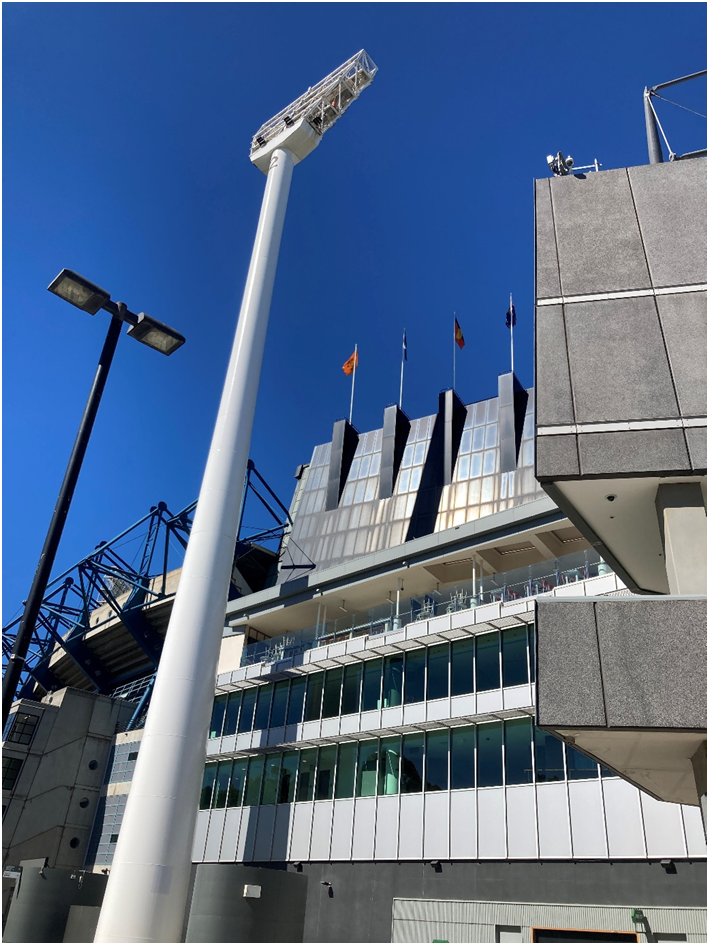
Friday, 27 December 2025
With the first day’s new-wicket shenanigans behind us, we look forward to Australia extending its lead of 46 runs into something befitting a Test Match. 300 runs, or 400. How about 500? We look forward with anticipation.
Boland, the nightwatchman, edges to Smith. But that’s okay. He’s done his job. The Australian lead is now well over 60.
Jake Weatherald, who has played his entire first-class career (152 innings) in the opening position, has been forced to No. 3 because of Boland’s desire to be two-thirds of a hat-trick. It doesn’t work: Weatherald elects, with disastrous consequences, to leave a ball that comes in with the arm.
The less said about the rest of the Australian batting the better, as an epidemic of poor judgement results in a cascade of wickets, and they limp to lunch at a woeful 6-98. It doesn’t improve after the break: Australia lose their last seven wickets for 50 runs after some minor resistance from Head and Smith. Khawaja holes out to sub-fielder Ollie Pope at deep fine leg before he has scored, so there is some consolation for a player left out of this match in dismissing another who might equally have been left out.
Steve Smith remains unbeaten, like a chimney left standing after a devastating house fire, but cops some criticism for taking the singles off the first ball of five different overs, leaving his less-qualified colleagues to fend for themselves against an attack buoyed by regular success. As a consequence, Neser (0), Starc (0) and Richardson (7) are soon disposed of, and the innings, barely 200 balls old, terminates in disappointment.
A quick check of the scoresheet reveals that Australia lost their last four wickets in each innings—a total of eight—for a mere 22 runs, in contrast to the resistance the tail provided in earlier Tests this summer. This is not a tried and true recipe for winning Test matches.
The only glimmer of hope for Australia lies in the fact that they’ve been bowled out for 132, the exact same score they made in the first innings at Perth, where, as we have seen, they went on to win. However, the Aussies clearly haven’t read the fine print: On this occasion it’s the second innings, thus rendering the precedent void.
England’s target of 175 has been set in an Ashes Test once before. Coincidentally, it was at the same ground, in 1998. On that occasion, it was Australia chasing, and they made a meal of it, falling short of their target by 13 runs.
Australian hopes for an easy win—indeed, any type of win—evaporate quickly as Duckett and Crawley start at a cracking pace. Crawley takes a relative backseat, despite a straight hit for six off Neser, but Duckett clearly has a bus to catch. He roars to 34 off 26 balls before Starc castles him. But the damage has been done, and England are already 51 after just seven overs.
Carse, who has shown not inconsiderable batting skills down the order this series, comes in at No. 3, but is unable to find the boundary in his short stay—although not through lack of trying.
Jacob Bethell succeeds him, playing the innings that clinches the match for England, a quickfire 40 off 47 balls, and displaying glimpses of the talent that has seen him promoted to this team despite not a lot of empirical evidence to support his case. Crawley and then Root support him, and when Bethell departs at 137, the game is as good as won. Harry Brook takes over and guides England to a four-wicket win, despite some late consolation wickets for Australia. As the sun bakes down in the late afternoon, there is a perceptible taming of the pitch, similar to that in Perth which allowed Travis Head go on his match-winning rampage. In that sense, things have evened up here.
The Test has lasted a mere 852 balls—still 196 more than the Test against South Africa in 1931-32, but there is no other match, out of the 116 others here, that has lasted for fewer than 1,000 balls.
In two days, and off those 852 balls, we have seen 36 wickets for 572 runs. That’s 15.88 runs per wicket, 4.02 runs per over, 23.7 balls per wicket. Cricket on steroids, not your normal Test-Match fare.
England’s win here breaks a drought stretching back to Sydney in 2011, when, just by the way, Usman Khawaja was making his Test debut.
Thus, for the second time this series, a game is done and dusted within two days. This is not the commercial outcome Cricket Australia were waiting for. They have been deprived of significant income, bearing in mind over 200,000 people attended the last three days of the corresponding match last year, when India stretched Australia out to five days.
Another 92,045 have turned up to see the end of this match, making 186,244 over the two days. But, for the first time ever, an Adelaide attendance (223,638) has trumped an MCG one.
Another two-dayer at Sydney (please, no) will see a repetition of the long-past 1888 series, when the scores were so low that all three matches ended within two days. In what must have been a horrific contest, Australia averaged 8.45 runs per wicket to England’s 15.10—hardly world-beating, but good enough to secure the series 2-1.
Sunday 28 December
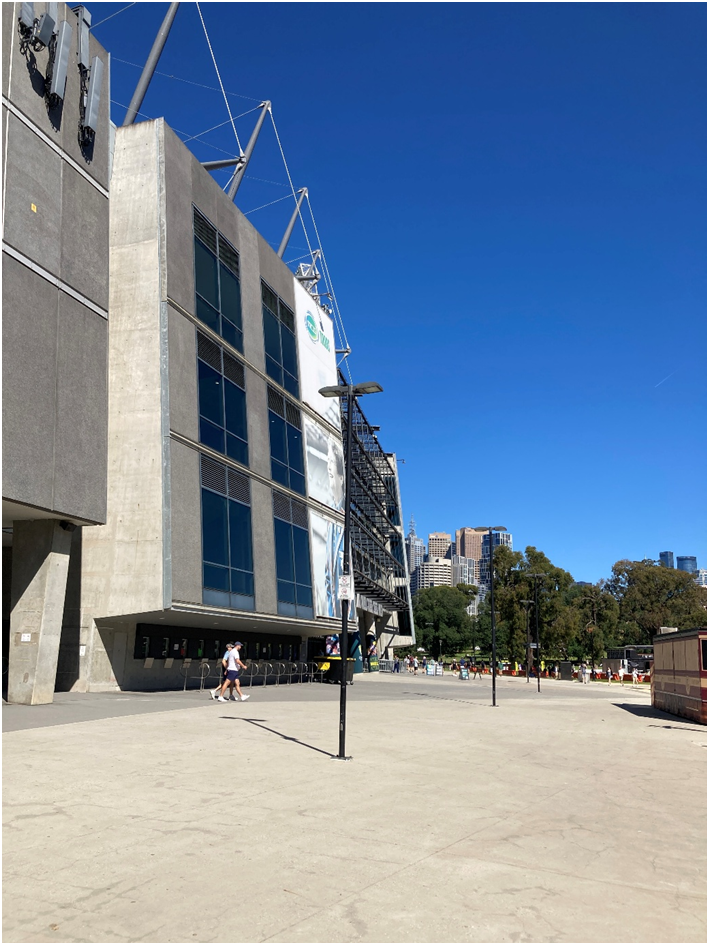
Day 3 dawns bright but sad—because there is no cricket.
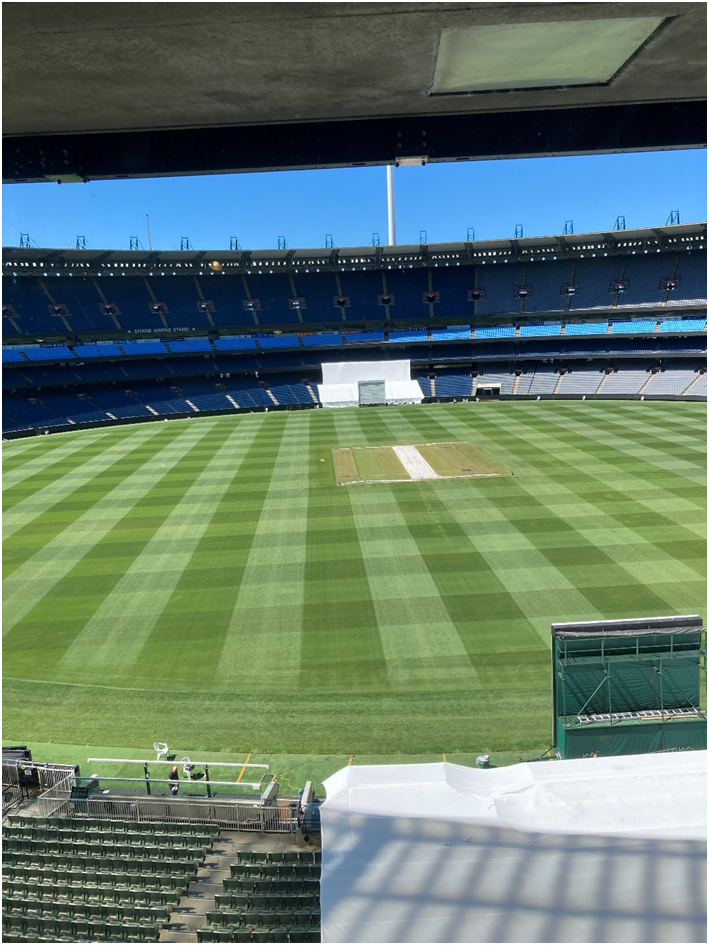
It could have been another 90,000 crowd. It turned out to be zero…
We still have airwaves to fill, though, this being a sporting Sunday, so we conduct the normal national Grandstand programme from our broadcasting box at the ground. Listeners from around the country get to call in and vent their frustration at the lack of cricket. Mid-afternoon we break up and wend our way home, all of us with a hollow feeling.
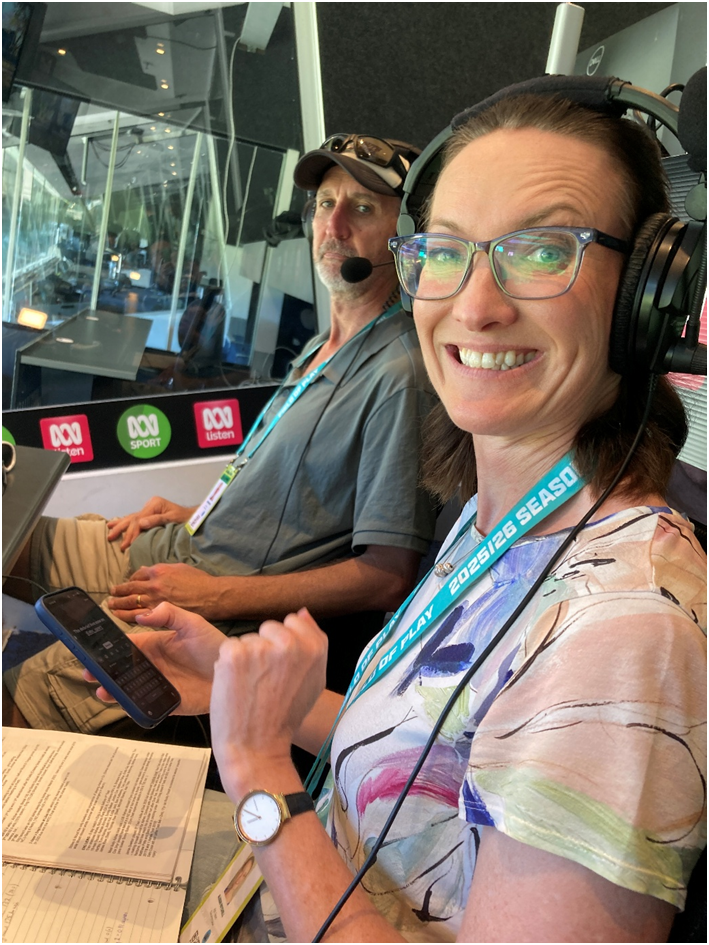
Jason Gillespie and Alison Mitchell are fully engrossed in our Grandstand programme
The outcome has a silver lining for me, however: My early return home means I can join my wife at our holiday shack at Bicheno, on the east coast of Tasmania, something I haven’t been able to do in the post-Christmas period for over 10 years. Bliss, watching the BBL on repeat! Just like the Test match…
 | A guest post by
|
I have enjoyed reading your Test summaries Ric 👏🏻