
At the Gabba Test
From the ABC statistician's notebook
Thursday
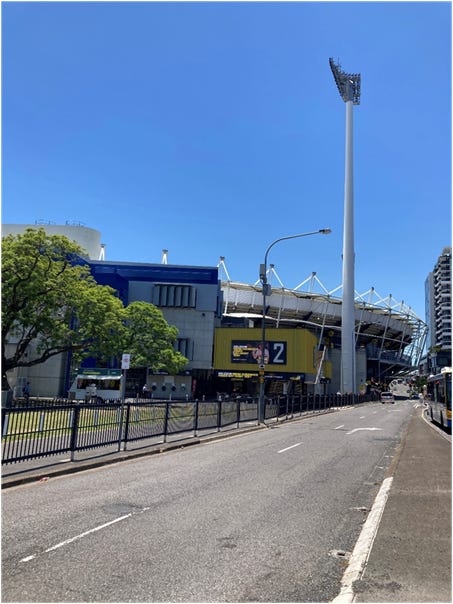
The cricket gods have decreed that the Gabba Test this year is to be deluge-free, which is not always the case, and a flawless day greets us as we meander to the ground for its 68th Test. But, sadly, it appears it’s not going to get much beyond 70. The picture above shows the ground straining to contain itself within its original block, overhanging the two roads that pass by it on either side. With Brisbane set to host the Olympic Games in 2032, a new stadium at Victoria Park over the river is set to become the new international cricket centre for Brisbane.
Australia’s record here (43 wins, 10 losses) is imposing, all the more so when it is discovered that in the 36 Tests here since 1990, Australia have only lost twice – to India in 2021 and to the Windies last season. For England, it must be particularly intimidating. They must have thought it a very friendly venue in 1936, having just won there, to match the result in their very first Test at the Gabba four years previously, but since then, only two more wins have come their way, the last in 1986, 39 years ago. They can be forgiven for thinking the Olympic Games are not a moment too soon.
I have the privilege to be working once again with some fine Australian cricket royalty. Darren Lehmann and Jason Gillespie have followed me to Brisbane, while Phil Jaques steps in to replace Tom Moody in Perth.
There is some conjecture that Pat Cummins will play in this match, despite not being in the squad. Recovering from a bung lumbar has taken time, but he is apparently ready to go.
It’s not Cummins who emerges from the tunnel with Ben Stokes for the toss, however, but Steve Smith, who filled in for Cummins in Perth. Australians are quite keen for Smith to skipper the side on this occasion. Since his sacking after SandPaperGate, he has acted as captain on seven occasions when the official captains have been unavailable, for 6 wins and a draw. Almost good enough for an Official Pardon, although the Barmy Army, who have taken up residence on the eastern side, clearly don’t agree with me.
Usman Khawaja hasn’t recovered from his back travails at Perth, and Josh Inglis is recalled, while Nathan Lyon’s spin is considered surplus to requirements, and is left out for Michel Neser. Lyon has no hesitation about letting the world know what he feels about this, and professes to any journalist who cares to listen that he is “filthy”.
These changes to the Australian team reduce its average age to 32.93 years, the 32nd-oldest Australian team in its history. But this is significant departure from Perth where the team was 33.86 years – the oldest Australian team since the ten teams of the 1920s (the last in 1938-29). As we have noted, it was no barrier to winning.
A quick check reveals that the toss-winner at the Gabba in the 23 Tests since 2002 have all elected to bat. It is easy see why. Nasser Hussain, 24 Gabba Tests ago, sent Australia in, and England lost by 384 runs. Ouch! Ben Stokes calls correctly, and predictably elects to bat.
So, it’s Crawley versus Starc for the first over of the Test once again, and unlike Perth, Crawley wins the first battle by taking a nice cover-driven four of the fourth ball. I announce that this, after one scoring shot, is now England’s best opening stand of the series.
Starc is not to be denied, however. Off the last ball of that first over, Duckett, his first ball, edges to Labuschagne at slip, emulating events at Perth. Starc now has six wickets in his last four “first over of a Test innings” - three wickets in the first over of the last Test v the Windies, two in Perth, and now one here.
Furthermore, Starc is cementing his reputation as an early destroyer of batting line-ups. In all Tests, he has 37 victims before the opposition have moved beyond a total of 5, second only to Sir Jimmy (64). Although he hasn’t done it this time, he has more wickets before the opposition has scored (16), even topping the great Glenn McGrath (13).
Starc cleans up Ollie Pope third ball, which brings Crawley and Joe Root together for a fine partnership of 117 for the third wicket. This is well short of the English record for this wicket at the Gabba, set last tour when Root (who made his highest score in Australia, 89) combined with David Malan to put on 162. But even so, it’s only the fourth century partnership for this wicket at the Gabba by an English team.
Root, having probably got heartily sick and tired of the “Joe Root has never made a Test century in Australia” publicity that preceded this tour, puts all of that behind him, and makes a magnificent undefeated 135 by stumps. It is my privilege to meet Joe’s parents Matt and Helen, who make a visit to our broadcasting box to chat during the lunch break.
Root has clearly put a lot of thought into this moment. He has cleverly manoeuvred his run tally for Tests in Australia to exactly 900 when he starts this Test. Which means when he gets to 100, he has scored exactly 1000 Test runs in Australia. Double milestone. Genius.
Ben Stokes is run out in spectacular fashion from cover by Josh Inglis, Leeds-born but happy to play against his country of birth. Doggett is the bowler, and he hasn’t been exactly a paragon of economy since his debut at Perth. His first over there was a maiden, but he hasn’t bowled one since. But on this occasion, he’s come up with five dot balls to Stokes, who is clearly feeling the pressure to score. He perishes off the sixth, courtesy of Inglis, and Doggett takes a little lesson how keeping things tight can produce a wicket. To be fair, up to this point, it seems he’s been told to bowl short to the English batters, who have been content to paddle them down to fine leg for a single.
One thing the English have been good at when playing Australia is avoiding run outs. Stokes is the first victim of this mode of dismissal since Rory Burns shared the same fate at Hobart in 2022, seven Tests ago.
It seems Doggett’s new-found economy is infectious. At 8:12 pm, Cameron Green commences an over to Joe Root, which turns out to be his first maiden in Tests for 21 months.
England look to be all out well before stumps, but Root combines with #11 Jofra Archer for a rollicking last-wicket stand that eventually reaches 70 when it ends early the next day. Len Hutton and Doug Wright (45 in 1950) are relegated to second-place on the list of tenth-wicket partnerships by England at the Gabba. Jofra triples his number of Test match sixes, launching Boland, then, impressively, Starc out of the park. His only other six was off Neil Wagner at Hamilton, NZ, six years ago in 2019.
Friday
Root and Archer’s 10th-wicket partnership of 70 is well short of the record for any country at this ground, 114 set by Jason Gillespie and Glenn McGrath way back when. There is a palpable sigh of relief from Jason when Archer edges Doggett to slip. I am sure I could detect beads of sweat leading up to this moment. Greatness prevails.
Root’s innings of 138* is only the third undefeated score of 138 by an English batter, after Wally Hammond (1929) and Dennis Amiss (1973). There’s an almost predictable rhythm to these things. I predict the next one will be in 2085.
Mitchell Starc continues his fine form from Perth, and bags another six wickets and he has now taken 22 wickets in his last four Test bowling innings. You can divide his career into 195 different sets of four consecutive innings, and this last has been his most productive. His previous best set, his 52nd, in 2016, earned him only 20 wickets.
Australia start with another 50-partnership, as they finished in Perth. That means Travis Head has been involved in all three of Australia’s last 50+ opening stands - today and at Perth with Weatherald, and in January in Sri Lanka with Usman Khawaja, 14 partnerships ago.
Brydon Carse, who went in excess of 8 runs an over for 5.2 in the second innings at Perth, continues to provide the Australians with bountiful scoring opportunities, and at one stage, has figures of 10.2-0-89-3 over the two innings (the second one in Perth, and this one) combined. The three wickets do, however, prevent further damage to the English bowling attack, disposing of Head, Green and Smith before they could make major contributions.
Jake Weatherald, in his second Test, looks the part in compiling an assured 72 at the top of the order. In doing so, he rises 180 places from is position at 472nd on the all-time Australian batting ladder after his debut duck last week, to 292nd place. None of his colleagues can claim such a meteoric rise when they make similar scores these days.
At 6:26 pm, Carse delivers his first maiden for 14 days, to Cam Green. His innings figures now read 10-1-72-1. This is the most expensive 10-over spell for England since Archer and Wood conceded82 and 75 respectively against Australia at Lahore last February. The problem here is that that was an ODI.
For the second day in a row, the middle session produces two wickets for 98 runs. For good measure, that was the return from the first session of the match, too. As you can tell, I love coincidences.
The first four partnerships of the Australian innings all exceed 50 runs, the first time since the Test against New Zealand here in 2015, and the first time against England since 2006, also here.
England, I note, drop five catches during the day, and Australia, mainly through the agency of Alex Carey, casually add 63 runs in the last dozen overs of the day against the wilting bowlers, when, historically, that is the hardest time to score runs under lights.
It is during this time that my friend Swamp at Channel 7 announces that Carse has achieved the second-fast century of the series so far (85 balls), after Head’s 69 balls at Perth and Root’s 181 balls yesterday. This is bordering cruel.
Saturday
Australia take firm hold of this Test when Australia add a further 133 runs today in nearly 45 overs before England can secure the last four wickets. There is clearly a plan for the Australian tail to soak up as much of the daylight hours as they can before England can start their second innings, and Carey, Starc, Boland and Doggett all play their part. England start their second innings at 6:13 pm under lights.
I try to cheer Jonathan Agnew up by revealing that there have been five previous Ashes series where the team losing the first Test goes on to win the series (Australia in 1897-98, 1901-02 and 1936-37, England in 1911-12 and 1954-55). I don’t think he buys it.
Five Australians reach fifty in their innings of 511, but no-one makes it to 100, the seventh time Australia has achieved this, and the third time against England.Remarkably, it happened three times in the summer of 2009-10 (against Pakistan and the Windies), while the last time against England was at Trent Bridge in 1997. The first time was at the MCG in 1908!
Starc reaches 77 before holing out to Ben Stokes, but in doing so, reaches 1408 runs batting at #9, thus overtaking Stuart Broad, watching on in the Channel 7 box, who has 1389. Only three others have 1000 runs there – Tim Southee, Dan Vettori and Brett Lee.
Another player-turned-journalist watching also suffers a takedown from Starc’s innings. Damien Fleming’s 71* against England in 1998 is relegated to second place in the list of highest scores by a #9 at the Gabba. I see Flem during a break shortly after, and he is clearly a broken man.
To complete the trifecta, the Starc-Boland partnership of 75 for the 9th wicket (there’s that 9 again!) is the highest in Tests for Australia at the Gabba. England have a little win here, though – Eddie Paynter and Hedley Verity’s stand of 92 in 1933 is still intact at the top of the list.
This innings also provides the lowest highest score (Starc’s 77) for any Australian total over 500 in its Test history. Previously, Simon Katich had held that with his 99 at Perth against the Windies at Perth in 2009 in Australia’s 7-520. In fact, there is only one lower highest score in any Test match – Mohinder Amarnath’s 70 in India’s 9-524 against New Zealand in 1976.
England commence their second innings in encouraging fashion, a boundary to Crawley in the second over taking them to 9, and thus their best opening stand of the series so far. Crawley in particular is keen to feed off this early success, and in in rollicking fashion, England motor to 0-45 at the tea/lunch/dinner break (there is general mayhem in this Test about the titling of the various breaks) off just six overs.
It all goes to porridge (the break might well have been breakfast) for England on resumption, though, losing Duckett at 48, and the score advances to just 134 by stumps, at a cost of of six batters – 6-89 in the session. This time, Starc relaxes his iron-grip on the wicket-taking column by allowing Michael Neser and Scott Boland to share equally in the spoils. England are still 43 runs behind, and with just four wickets left, are all but doomed. It is noted that Australia’s tactics of hogging the daylight for batting has been largely successful in this Test – 11 of the first 16 England wickets have fallen in the night session.
England’s collapse is somewhat predictable, it must be said. A little research reveals that his bowling average for those innings immediately after he has made a fifty whilst batting is a mere 22, when his overall average is closer to 27. The key to nobbling Starc’s bowling is to get him out cheaply.
Joe Root, already enjoying a memorable match, creates another significant milestone when he edges Starc to Carey. His wicket is the 6000th taken by Australia in Tests against England, and thus joins JT Tyldesley (1000, 1902), Nawab of Pataudi (2000, 1932), Brian Statham (3000, 1963), David Gower (4000, 1983) and Michael Vaughan (5000, 2003) as Milestone Markers. Strangely enough, every one of these milestones occurred in Australia.
Sunday
English skipper Ben Stokes and Will Jacks, playing his first Ashes Test, bat resolutely on the fourth afternoon, in complete contrast to the revolving-door cricket witnessed the previous night, and not a wicket falls before the first Lunch/Tea/Dinner/Breakfast break. The score advances by only 59, but it means that Australia will now need to bat again if they are to win this match.
Stokes and Jacks take their 7th wicket partnership to 96, a record for England at the Gabba (goodbye, Peter Parfitt and Fred Titmus, 64 in 1962) before Steve Smith takes a left-handed screamer at first-slip off Michel Neser to make Australia’s first breakthrough of the day.
Jack’s dismissal halts a depressing outlook for those commencing a new day’s play at the crease in this Test summer. On the previous five days of this Ashes series, wickets have fallen after 6, 38, 6, 14 and 18 balls. Jack goes after 205 balls today, more than doubling the balls faced by England the previous day, and opening batters on both sides breathe a huge sigh of relief. It can be done.
With Jack’s dismissal, the dam wall bursts, and Stakes falls to the same bowler shortly after, having just completed a defiant fifty. Neser, the man the selectors turn to when looking for a spare bowler, now has four wickets in an innings for the first time in his four Tests.
When Carse falls to the Smith/Neser combination moments later to wrap up the innings, Neser has five, and thus colludes with Starc to provide only the second instance of two Australian bowlers aged 35 each taking five wickets in an innings in the same Test. The only other occasion? McGrath and Warne at Christchurch in 2005.
Australia has had 70 bowlers roll the arm over when aged 35, and three of the four top performers at that age are playing in this Test. Scott Boland (now aged 36) took 21 wickets at 13,19 when aged 35, Neser has six wickets at 14.17, and Starc 41 wickets at 15.61. The only other bowler in between is the mystery spinner of the early 1950s Jack Iverson, who had 21 wickets at 15.24.
Australia are set a mere 65 to win, and polish off the task in exactly 10 overs under the lights. Gus Atkinson, not having the success he would have wanted in this series, takes two late wickets, but the main entertainment in the last stanza of this Test is provided by Jofra Archer, who cranks his speed up to the high-140s, and Steve Smith, who is not impressed.Having hammered Archer through square leg for four, he then top-edged a searing bouncer over the wicket-keeper for another, and next ball, planted him over fine-leg for six. A sumptuous on-drive from Atkinson next over takes him to 23 off nine balls, and Australia to an eight-wicket win.
The margin of victory was destined before it happened. The only other time Australia was set 65 to win a Test was in 1963 – and, you guessed, Australia got home by eight wickets.The observant reader will have picked up that the margin of victory at Perth was also eight wickets. However, this needs to keep happening – it requires another eight-wicket win at Adelaide to equal Australia’s record of successive Test wins by eight wickets, set in 1958, when successive matches at Pert Elizabeth, Brisbane and Melbourne were all won by that exact margin.
Stokes thus has to emulate Bradman in 1936-37, when with scores of 270, 212 and 169, he reversed a scoreline of 0-2 to engineer a 3-2 series win. See you in Adelaide!